


Investors face difficult trade-offs today: Improving yield often means accepting lower credit quality, longer duration or reduced liquidity. Preferred securities can help address these compromises across a range of fixed income allocations.
KEY TAKEAWAYS
- Income driven by structure, not credit risk
Preferreds often offer yields comparable to lower-rated debt even though their issuers are primarily investment grade, reflecting subordination rather than weaker credit quality. - Enhance performance potential while maintaining risk
Distinct issuer exposures, differentiated return drivers and favorable tax treatment have historically supported preferreds diversification benefits and attractive risk-adjusted returns. - One asset class, multiple portfolio roles
From multisector bonds, municipals and high yield to private credit and cash, five applications show how preferreds can serve as a strategic complement or alternative to fixed income allocations.
1. Add diversification and return in a multisector portfolio
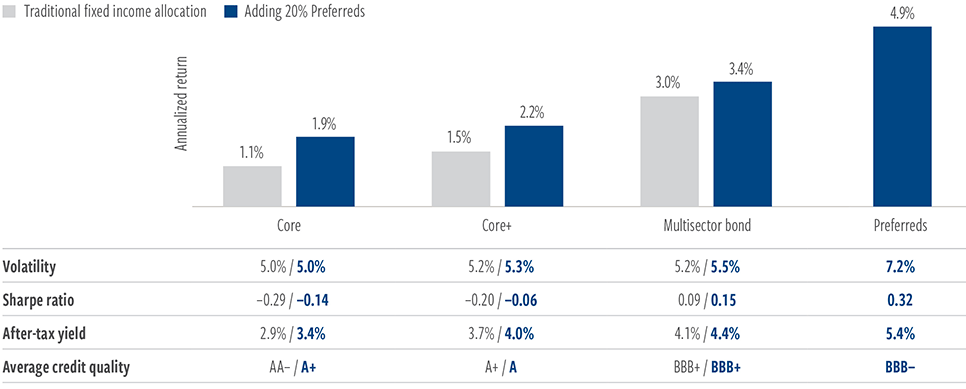
Preferred securities provide a compelling complement to traditional multisector fixed income allocations. Their relatively high income, distinct return drivers and diversification across regions and sectors can help investors navigate difficult trade-offs between income, duration and credit risk without significantly changing the overall risk profile. In the hypothetical 10-year analysis in Exhibit 1, replacing 20% of core, core+ or multisector bond allocations with preferreds increased annualized returns and after-tax yields. Risk-adjusted returns also improved across all three allocations, while volatility remained broadly comparable.
These potential benefits reflect the unique characteristics of the preferreds market. Issuance is concentrated among high-quality banks, insurers and utilities, many of which operate under significant regulatory oversight.
Preferreds therefore offer yields that compare favorably with lower-rated debt, even though their issuers are often investment-grade companies.
Preferreds’ distinct issuer mix and structural features can introduce additional return drivers, which can drive their diversification benefits within a broader fixed income portfolio. Investors may also consider using preferreds to pursue higher income and return potential while maintaining a balanced approach to portfolio risk, particularly amid current interest rate uncertainty.
EXHIBIT 1
Preferreds may enhance income and returns without materially increasing risk
10-year return analysis
At September 30, 2026. Source: ICE BofA, Morningstar, Cohen & Steers.
Past performance is no guarantee of future results. Core, Core+ and Multisector bond portfolio statistics are based on their respective Morningstar category averages. Preferreds are represented by the ICE BofA US Institutional Capital Securities Index. Yields shown are the average of surveyed Morningstar category constituents on an after-tax basis.
2. Increase after-tax income without extending duration
With income likely to be an important driver of fixed income returns, taxable investors should consider not only headline yield, but also how much income they retain after taxes.
Preferred securities are unusual among fixed income investments because a substantial portion of their distributions may qualify as qualified dividend income (QDI) and be taxed at just 20% (plus the 3.8% Medicare surcharge) for U.S. investors in the highest tax bracket—versus 40.8% total for interest income. As a result, preferreds have historically offered some of the highest after-tax income levels available among fixed-income markets.
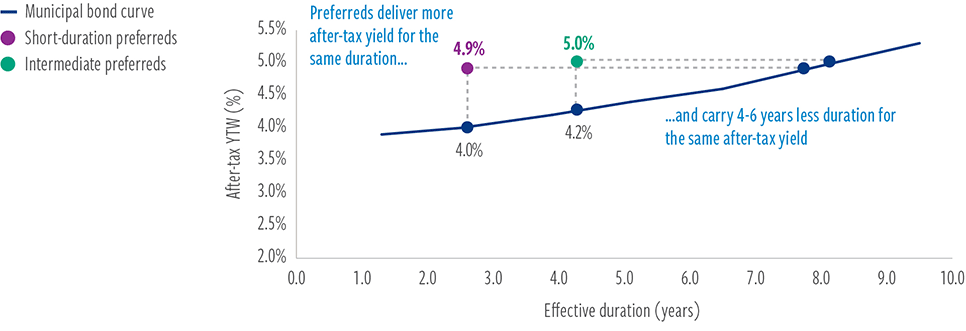
The combination of attractive nominal yields and favorable tax treatment can provide a greater income cushion against interest-rate and credit- spread volatility and help preferreds stack up well against municipal bonds (Exhibit 2). For those focused on income generation rather than capital preservation alone, preferreds may increase after-tax income efficiency.
Preferreds provide higher income per unit of duration than many traditional fixed-income sectors. This can allow investors to achieve comparable after- tax income while assuming meaningfully less interest-rate sensitivity.
EXHIBIT 2
Combining preferreds with munis can improve income efficiency
After-tax yield per unit of duration
At September 30, 2026. Source: ICE BofA, Bloomberg, Cohen & Steers.
Past performance is no guarantee of future results. For yield curve data: Municipal bond curve is represented by the Bloomberg Municipal Bond Index. Short-duration preferreds and intermediate preferreds represented by the ICE BofA 8% Constrained Developed Markets Low Duration Capital Securities Custom Index and ICE BofA US Institutional Capital Securities Index, respectively. For return data: Preferreds are represented by the ICE BofA US Institutional Capital Securities Index. Municipals are represented by the Morningstar US Fund Muni National Intermediate category average. Short-duration preferreds are represented by the ICE BofA 8% Constrained Developed Markets Low Duration Capital Securities Custom Index. Yield-to-worst (YTW) reflects all possible scenarios, such as holding a bond to final maturity date or the issuer calling it on an allowable call date
3. Improve credit quality in a high yield portfolio
Many investors turn to high-yield bonds to pursue incremental income. However, with credit spreads currently leaving limited room for weakness, investors receive only modest incremental compensation for the materially lower credit quality associated with high yield.
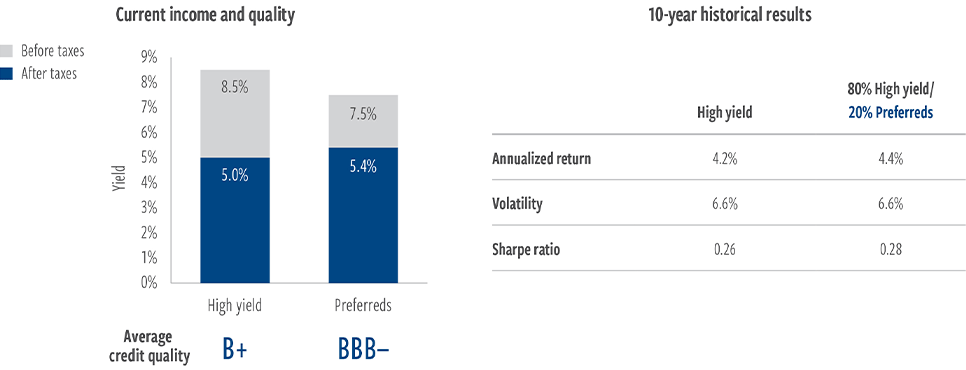
Preferred securities offer a different approach (Exhibit 3). Most preferreds are issued by high-quality companies, yet they typically offer yields comparable to those available in below-investment-grade bonds. Preferred holders are compensated primarily for subordination and structural complexity rather than for owning securities from weaker issuers.
We believe investors can maintain attractive portfolio income while improving overall credit quality by shifting a portion of their high-yield allocation into preferreds. Historical data show that the asset class has produced competitive risk-adjusted outcomes. Its distinct sector exposures also complement high-yield holdings.
Preferreds may therefore appeal to those seeking income without relying exclusively on lower-quality credit allocations.
EXHIBIT 3
Adding preferreds can improve portfolio quality while maintaining comparable income
Income, credit quality and 10-year portfolio outcomes
At September 30, 2026. Source: ICE BofA, Morningstar, Cohen & Steers.
Past performance is no guarantee of future results. High yield bond portfolio statistics represented by the Morningstar high yield bond category. Preferred securities are represented by the ICE BofA US Institutional Capital Securities Index. Yields shown are the average of surveyed Morningstar category constituents on an after-tax basis. After-tax yields assume taxation at the highest marginal U.S. Federal income tax rates of 37% for taxable interest income and 20% for QDI, with an additional 3.8% Medicare surcharge on all tax rates. After-tax calculations assume preferred securities income is taxed at the respective qualified dividend rate and marginal tax rate on a 75/25 blended basis. High yield bonds reflect full taxation at the marginal rate based on income. State and local taxes are not included. Calculations assume 75% QDI for preferreds. Credit ratings represented by the weighted-average ICE Composite credit rating of the respective indexes. Volatility is measured by standard deviation, a measure of variation around an average. The Sharpe ratio measures excess return per unit of risk.
4. Gain liquid access to private-credit-like returns
Private credit, such as direct lending, has attracted significant investor interest over the past decade. But the extra income that private credit generates is there for a reason. Years of record fundraising have pushed capital into increasingly competitive markets, driving allocations to smaller and middle-market borrowers.
The composition of the private credit market also warrants attention. Software companies account for roughly 30% of private credit deal value, leaving many portfolios dependent on business models that may face disruption as artificial intelligence reshapes competitive dynamics.
Meanwhile, AI is creating opportunities for many large, established companies, including those in banking, insurance and utilities, the primary issuers of preferreds, while its implications for smaller software firms remain less certain.
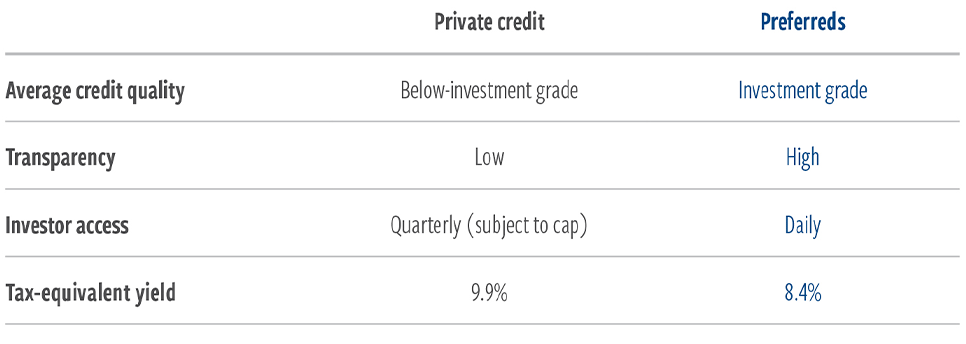
In today’s low credit spread environment, the incremental compensation available in private credit may not fully offset these risks. We believe preferred securities offer an attractive combination of yield, credit quality, liquidity and transparency that serve as a complement to a private credit allocation (Exhibit 4).
Unlike private credit, preferreds are issued primarily by large, publicly traded, investment-grade companies. Investors benefit from public financial disclosure, daily pricing and continuous liquidity. By contrast, private-market investments typically provide less transparency and more limited liquidity, and redemption restrictions would become more onerous during periods of stress.
EXHIBIT 4
Preferreds can deliver high income with greater quality, transparency and liquidity
Key comparisons between private credit (direct lending) and preferreds
At September 30, 2026. Source: ICE BofA, Preqin, Bloomberg, Cohen & Steers.
Preferreds are represented by the tax-equivalent yield-to-worst for the ICE BofA US Institutional Capital Securities Index. Private credit yield is as of June 30, 2026 (the latest available data) and is represented by the trailing four-quarter income return through 1Q26 for the Cliffwater Direct Lending Index. Sector data are based on total deal value and categorized using Preqin sector mappings. Small and middle-market companies are generally defined as companies with less than $1 billion in annual revenue. In contrast, for example, the 50 largest public issuers of preferreds by market capitalization have average annual revenue of $24 billion. Although private credit ratings are generally unknown, which contributes to its lower transparency, 100% of the companies that converted from public to private ownership were rated single-B or lower prior to conversion, according to S&P Global
5. Unlock more value from excess cash
Many investors currently maintain meaningful allocations to cash and short- term instruments. Although cash yields have risen in recent years, large cash allocations create reinvestment risk if short-term rates decline and can impose opportunity costs, particularly for investors with longer investment horizons. For those seeking additional income while emphasizing quality, short-duration preferred securities may bridge the gap between cash and traditional intermediate-term fixed income.
Through their resetting coupons, these securities offer the potential for substantially higher income than cash while having less duration than many conventional bond portfolios, making them less sensitive to changes in interest rates.
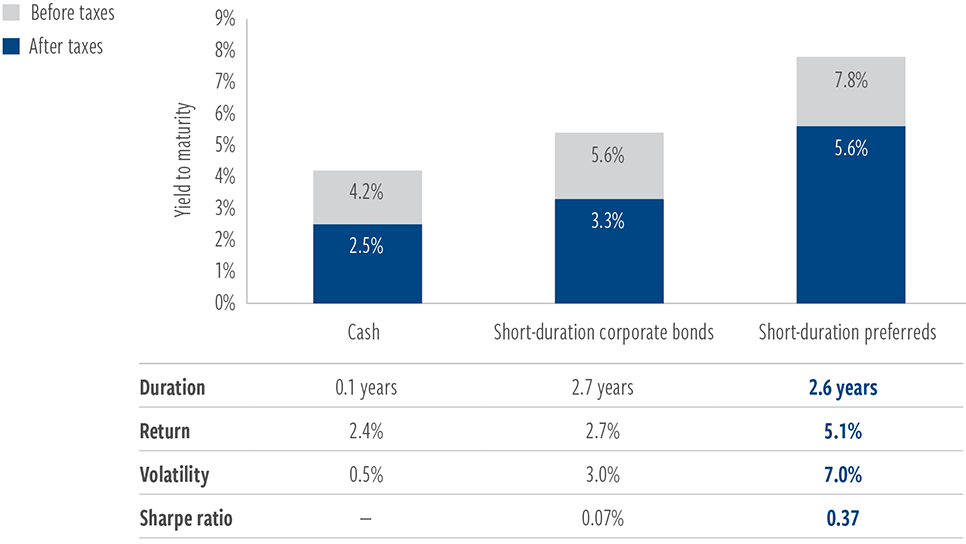
And as mentioned previously, preferreds are unusual among fixed income investments because a substantial portion of their distributions may qualify as qualified dividend income, which is typically taxed at lower rates than ordinary interest income. As shown in Exhibit 5, preferreds currently provide roughly 300 basis points more of after-tax income than cash.
When cash holdings exceed near-term liquidity needs, reallocating a portion of those balances to preferreds have the potential to enhance income without compromising on duration, credit quality or liquidity. Although preferreds historically have displayed greater volatility than cash or short- duration corporate bonds, we believe investors are compensated for that additional risk through the higher income and returns potential perferreds can offer over time.
EXHIBIT 5
Short-duration preferreds can double income while preserving investment-grade quality
10-year return analysis
At September 30, 2026. Source: ICE BofA, Cohen & Steers.
Past performance is no guarantee of future results. Returns, volatility (standard deviation) and the Sharpe ratio based on 10-year average annualized performance. Cash is represented by the ICE BofA 1-3 Month US Treasury Index. Short-duration corporate bonds are represented by the ICE BofA 1-5 Year US Corporate Index. Short-duration preferreds are represented by the ICE BofA 8% Constrained Developed Markets Low Duration Capital Securities Custom Index.
ABOUT THE AUTHORS

Elaine Zaharis-Nikas, CFA, Executive Vice President, is Head of Fixed Income and Preferred Securities and a senior portfolio manager for the firm’s preferred securities portfolios.

Jerry Dorost, CFA, Senior Vice President, is a portfolio manager for fixed income and preferred securities portfolios and has analyst coverage responsibilities for U.S. banks.

Robert Kastoff, CFA, Vice President, is a portfolio manager for fixed income and preferred securities portfolios and has analyst coverage responsibilities for real estate and telecommunication industries.
Index definitions and important disclosures
An investor cannot invest directly in an index, and index performance does not reflect the deduction of any fees, expenses or taxes.
Preferred securities: Intermediate duration: ICE BofA U.S. I.G. Institutional Capital Securities Index (credit quality: BBB) tracks the performance of U.S. dollar-denominated investment-grade hybrid capital corporate and preferred securities publicly issued in the U.S. domestic market. Short duration: ICE BofA 8% Constrained Developed Markets Low Duration Capital Securities Custom Index tracks the performance of U.S. dollar-denominated preferred, hybrid capital and subordinated securities from developed-market issuers emphasizing shorter-duration structures; the index is constrained to limit issuer concentration. Short duration corporate bonds: ICE BofA 1-5 Year US Corporate Index tracks the performance of Investment-grade U.S. corporate bonds with 1-5 years to maturity. High yield bonds: ICE BofA High Yield Bond Index (credit quality: B+) tracks the performance of U.S. dollar-denominated below-investment-grade corporate debt publicly issued in the U.S. domestic market. Municipal bonds: Bloomberg Municipal Bond Index tracks the performance of U.S. dollar-denominated long-term, tax-exempt bonds issued by U.S. state and local governments. Cash: ICE BofA 1-3 Month U.S. Treasury Index tracks the performance of U.S. Treasury bills and other Treasury securities with remaining maturities of one to three months, representing the short-term risk-free segment of the U.S. fixed income market. Private credit: Cliffwater Direct Lending Index measures the performance of U.S. middle-market direct lending through privately originated loans held by business development companies and other direct lenders; the index is designed to represent the investable U.S. private credit/direct lending market.
Data quoted represents past performance, which is no guarantee of future results. This material is for informational purposes and reflects prevailing conditions and our judgment as of this date, which are subject to change. There is no guarantee that any market forecast set forth in this presentation will be realized. This material represents an assessment of the market environment at a specific point in time and should not be relied upon as investment advice, does not constitute a recommendation to buy or sell a security or other investment, and is not intended to predict or depict performance of any investment. This material is not being provided in a fiduciary capacity and is not intended to recommend any investment policy or investment strategy or to take into account the specific objectives or circumstances of any investor. We consider the information in this presentation to be accurate, but we do not represent that it is complete or should be relied upon as the sole source of appropriateness for investment. Please consult with your investment, tax or legal professional regarding your individual circumstances prior to investing.
Risks of investing in preferred securities. An investment in a preferred strategy is subject to investment risk, including the possible loss of the entire principal amount that you invest. The value of these securities, like other investments, may move up or down, sometimes rapidly and unpredictably. Our preferred strategies may invest in below-investment-grade securities and unrated securities judged to be below investment grade by the Advisor. Below-investment-grade securities or equivalent unrated securities generally involve greater volatility of price and risk of loss of income and principal, and may be more susceptible to real or perceived adverse economic and competitive industry conditions than higher-grade securities. The strategies’ benchmarks do not contain below-investment-grade securities.
Contingent capital securities (CoCos). CoCos are debt or preferred securities with loss absorption characteristics built into the terms of the security, for example a mandatory conversion into common stock of the issuer under certain circumstances, such as the issuer’s capital ratio falling below a certain level. Since the common stock of the issuer may not pay a dividend, investors in these instruments could experience a reduced income rate, potentially to zero, and conversion would deepen the subordination of the investor, hence worsening the investor’s standing in a bankruptcy. Some CoCos provide for a reduction in the value or principal amount of the security under such circumstances. In addition, most CoCos are considered to be high yield securities and are therefore subject to the risks of investing in below-investment-grade securities.
Duration risk. Duration is a mathematical calculation of the average life of a fixed income or preferred security that serves as a measure of the security’s price risk to changes in interest rates (or yields). Securities with longer durations tend to be more sensitive to interest rate (or yield) changes than securities with shorter durations. Duration differs from maturity in that it considers potential changes to interest rates, and a security’s coupon payments, yield, price and par value and call features, in addition to the amount of time until the security matures. Various techniques may be used to shorten or lengthen the Fund’s duration. The duration of a security will be expected to change over time with changes in market factors and time to maturity.
Cohen & Steers Capital Management, Inc. (Cohen & Steers) is a U.S. registered investment advisory firm that provides investment management services to corporate retirement, public and union retirement plans, endowments, foundations and mutual funds. Cohen & Steers Asia Limited is authorized and regulated by the Securities and Futures Commission of Hong Kong (ALZ367). Cohen & Steers Japan Limited is a registered financial instruments operator (investment advisory and agency business and discretionary investment management business with the Financial Services Agency of Japan and the Kanto Local Finance Bureau No. 3157) and is a member of the Japan Investment Advisers Association. Cohen & Steers UK Limited is authorized and regulated by the Financial Conduct Authority (FRN458459). Cohen & Steers Ireland Limited is regulated by the Central Bank of Ireland (No.C188319). Cohen & Steers Singapore Private Limited is a private company limited by shares in the Republic of Singapore.