
Infrastructure Knowledge Center
Allocations to listed infrastructure have grown in recent years as investors seek real assets with steady cash flows and the potential for strong returns. We examine the asset class’s historical investment characteristics and the powerful long-term trends fueling global investment in infrastructure.
What is infrastructure and why is it important
Infrastructure provides the backbone of modern life—and the foundation for the future. It powers our homes, connects our devices and facilitates the movement of people, goods and services across the globe. From energy grids, to data networks and transportation logistics, these essential assets make the world operate, grouped into four main categories: communications, midstream energy, transportation and utilities. But infrastructure is more than what we rely on today—it’s the gateway to the future’s most critical megatrends.
Infrastructure powers the global economy

At June 30, 2025. Based on Cohen & Steers’ expectations.
The views and opinions are as of the date of publication and are subject to change without notice. There is no guarantee that any market forecast set forth in this presentation will be realized.
These businesses have common characteristics that unite them as an asset class:
- Long-lived assets: Infrastructure assets typically have useful lives of several decades, providing a long-term source of income.
- High barriers to entry: Strict zoning restrictions, large capital requirements and, in some cases, exclusivity agreements make it difficult or prohibitive for competitors to enter the market.
- Inelastic demand: Infrastructure provides essential services that often remain in demand even in periods of economic downturns.
- Predictable cash flows: Infrastructure assets are often regulated or operate under long-term contracts or concession agreements, typically resulting in greater cash flow stability relative to many other businesses.
Key potential benefits of investing in listed infrastructure
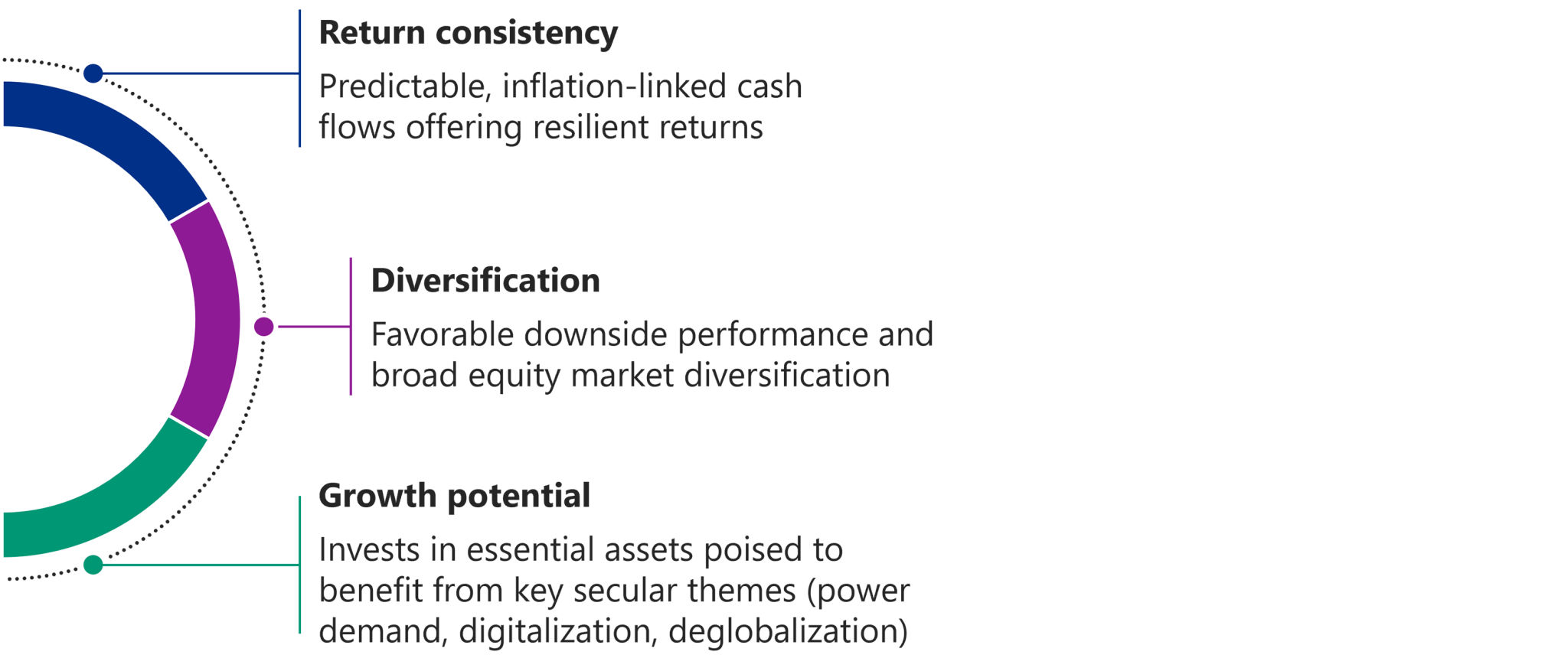
At June 30, 2025.
Data quoted represents past performance, which is no guarantee of future results. The views and opinions in this presentation are as of the date of publication and subject to change without notice. There is no guarantee that any market forecast set forth in this presentation will be realized. There is no guarantee that any historical trend illustrated above will be repeated in the future, and there is no way to predict precisely when such a trend will begin.
A wave of capital may be forming
In addition to attractive returns and diversification benefits, infrastructure can provide access to exciting growth opportunities. Oxford Economics and the World Bank’s Global Infrastructure Hub projects the world needs to spend $94 trillion on infrastructure by 2040 to support growing populations and economic expansion. And yet, current projections anticipate only $79 trillion will be spent—predominantly by governments that remain plagued with high debt burdens and an inability to pay without larger repercussions.
Who will fulfill the estimated $15T shortfall?
In this era of strained government budgets, we believe the private sector will play a major role in closing the funding gap, through the privatization of government assets, the redevelopment of legacy projects and new construction. This will create expanding investment opportunities and a growing asset base for investors to capitalize on.
A generational opportunity in infrastructure capital formation is beginning
We believe demand for infrastructure capital exceeds government funding capabilities
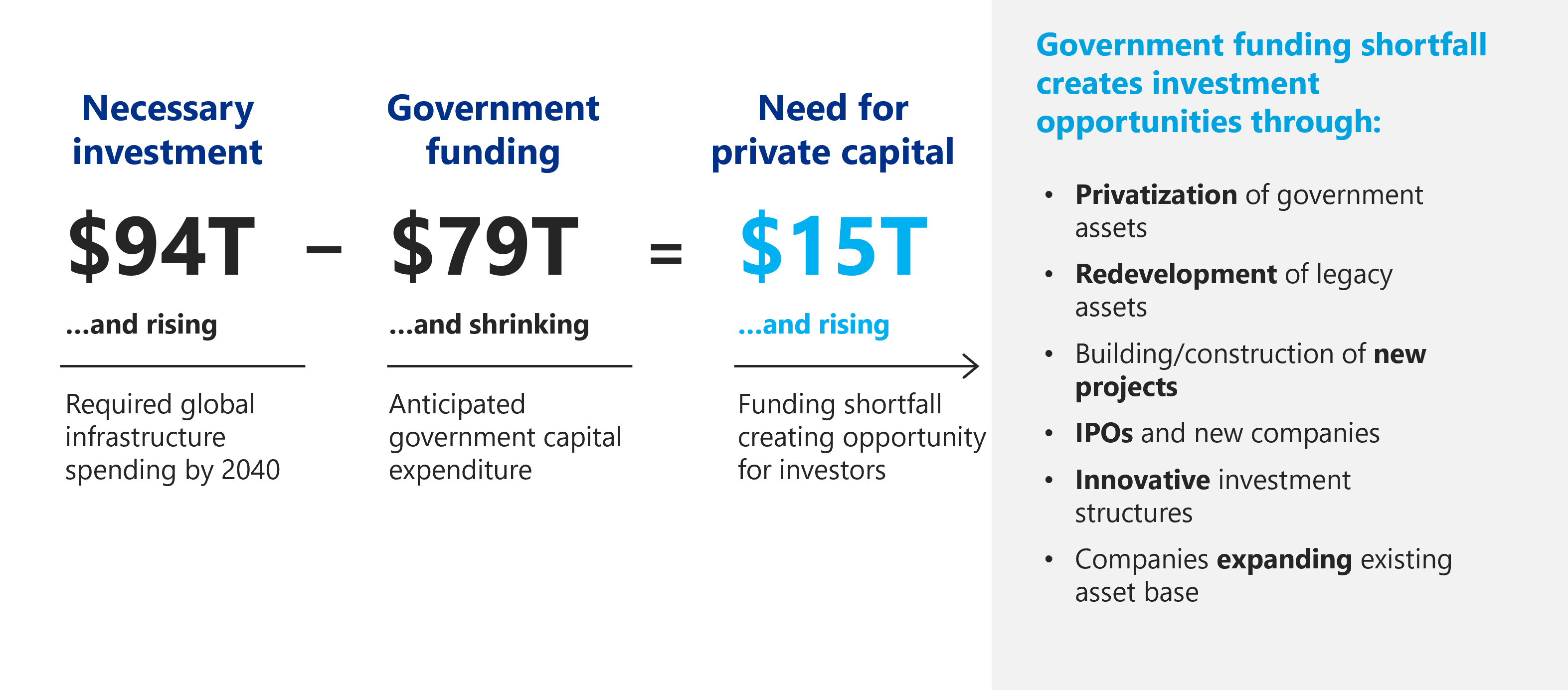
At June 30, 2025. Source: World Economic Forum, World Bank Group, Cohen & Steers.
The views and opinions are as of the date of publication and are subject to change without notice. There is no guarantee that any market forecast will be realized. There is no guarantee that any historical trend illustrated above will be repeated in the future, and there is no way to predict precisely when such a trend might begin.
Secular themes are driving opportunities in infrastructure
Today, we see three secular trends that make infrastructure a particularly attractive investment. Utilities, renewable energy and midstream companies stand to benefit from rising power demands and decarbonization, as the world works to balance critical energy needs with the push to reduce carbon emissions—a challenging combination. Data centers, cellular towers and satellites all stand to benefit from the digitalization of economies, increasingly focused on the vital need for data. Finally, efficient and functional marine ports, airports and railways have become increasingly critical as geopolitical tensions rise, globalization slows, and countries rely more heavily on domestic logistics. Ongoing investment and innovation are essential to support these trends.
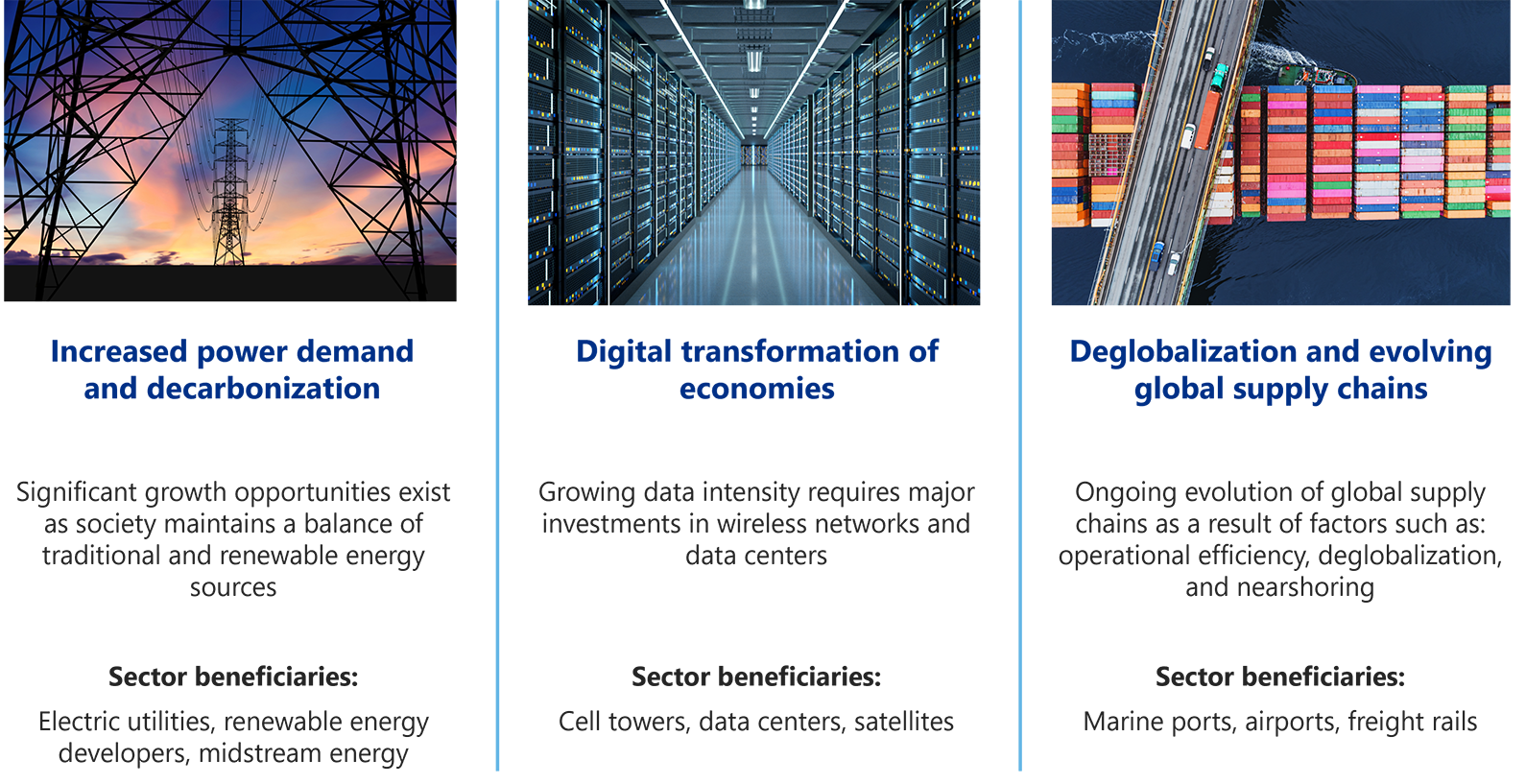
At June 30, 2025. Source: Cohen & Steers.
The information presented above does not reflect the performance of any fund or other account managed or serviced by Cohen & Steers, and there is no guarantee investors will experience the type of performance reflected above. There is no guarantee that any historical trend illustrated above will be repeated in the future, and there is no way to predict precisely when such a trend might begin. The views and opinions in this presentation are as of the date of publication and subject to change without notice. There is no guarantee that any market forecast set forth in this presentation will be realized. Images sourced from Google images, Shutterstock, Microsoft and GEP, respectively.
Infrastructure: a unique access point into the data and AI revolution
Specifically on digitalization and power demand, AI and supercomputers are driving an insatiable growth in data. Analysts forecast a tenfold surge in the amount of information we will create by 2035. However, data centers, which are critical in supplying and storing this data, face seemingly insurmountable energy needs that current energy systems cannot support. This is resulting in a rise in power demand from utilities not seen in decades, which we believe will propel capital formation and investment across the utilities, communications and midstream sectors.
“The world’s most valuable resource is no longer oil, but data”
The Economist
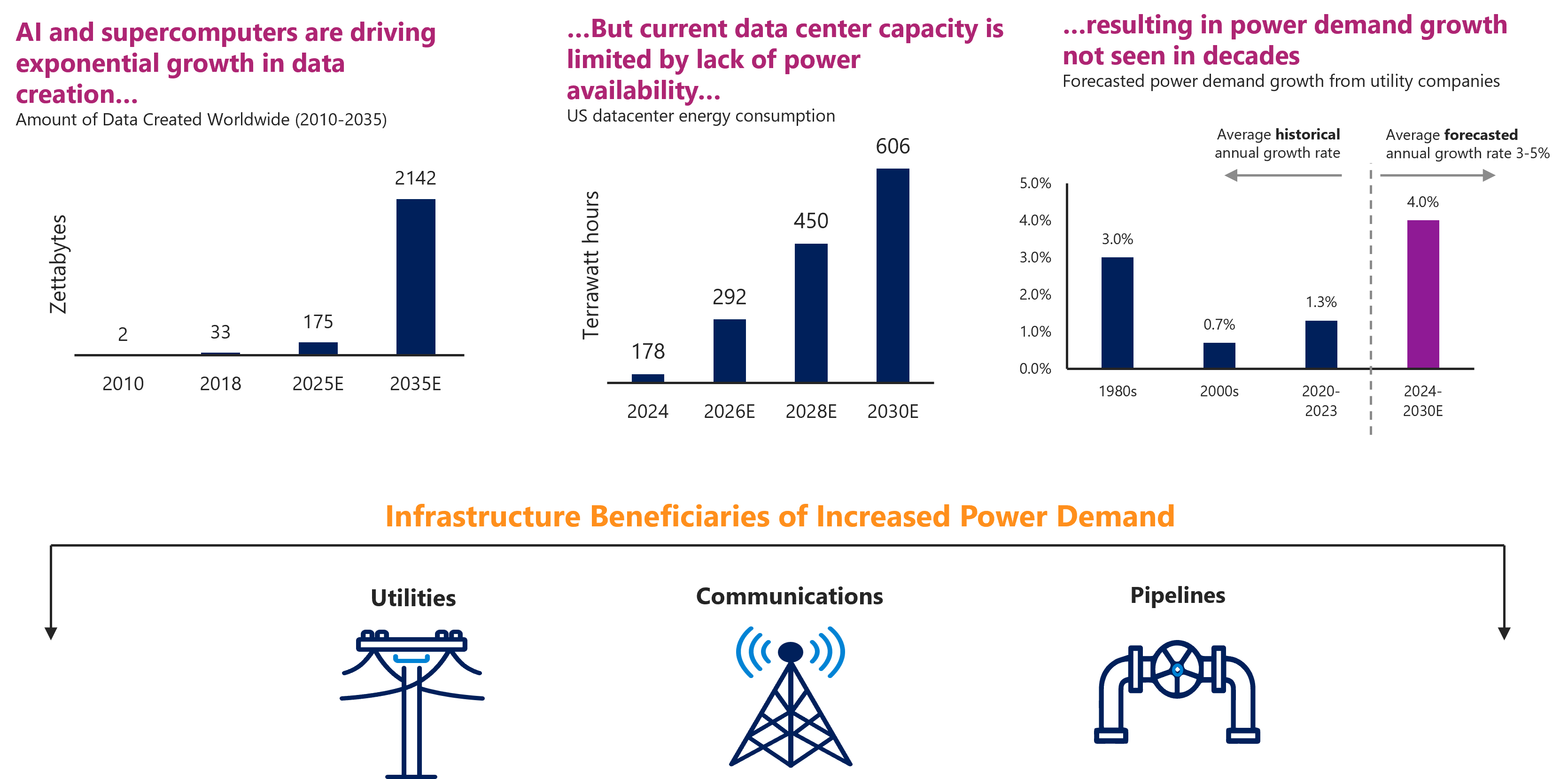
Source: Statista, McKinsey Energy Solutions Global Energy Perspective.
Compelling characteristics: attractive returns with diversification and defensive qualities
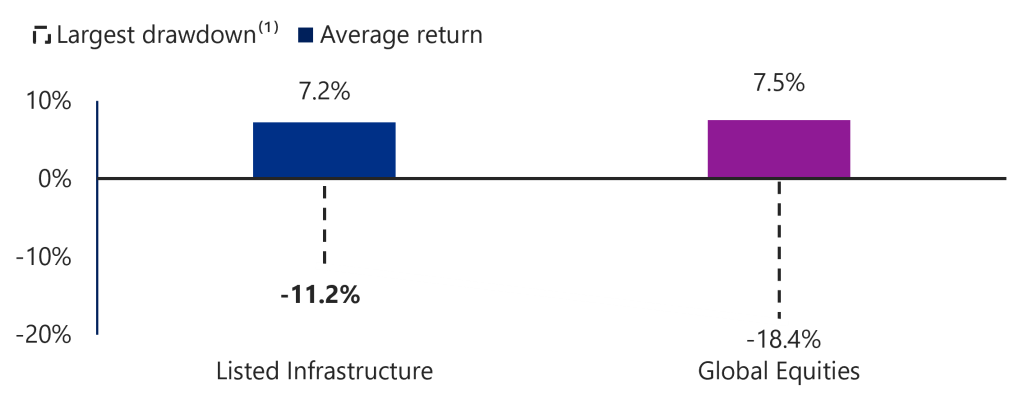
Attractive return profile with lower drawdown
Listed infrastructure vs. global equities (3-year rolled returns)
January 1995 – June 2025
Low equity beta with favorable downside protection

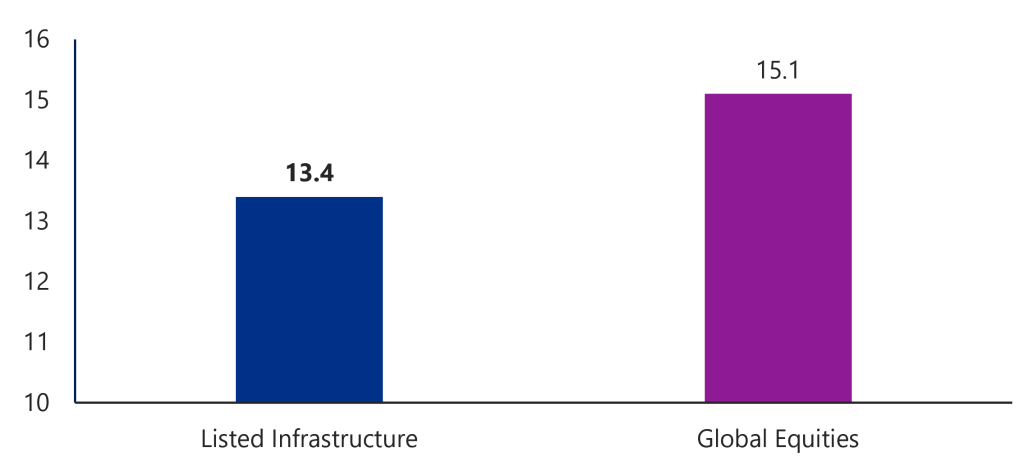
Lower risk
Listed infrastructure vs. global equities Volatility (%)
January 1995 – June 2025
Source: Bloomberg, Cohen & Steers. Data quoted represents past performance, which is no guarantee of future results. There is no guarantee that any historical trend illustrated above will be repeated in the future, and there is no way to predict precisely when such a trend will begin. The views and opinions in this presentation are as of the date of publication and subject to change without notice. There is no guarantee that any market forecast set forth in this presentation will be realized.
Listed infrastructure represented by Linked UBS Global 50/50 Net/FTSE Global 50/50 Net. Global equities is represented by the MSCI World Index Net.
(1) Largest drawdown refers to the rolled 3-year period with the lowest return over the course of the stated time period.
Cohen & Steers’ competitive advantages
Cohen & Steers is uniquely positioned as a leader in real assets. Offering one of the largest listed infrastructure franchises in the industry and over 20 years of investment expertise, Cohen & Steers remains committed to its long legacy of investment excellence.
 | • Large, seasoned and dedicated infrastructure investment team • Portfolio managers, analysts and traders located in key markets globally |
 | • $10.1 billion in assets under management • Size provides advantageous access to company management and key market participants; ample capacity to grow assets |
 | • Rigorous 20+ year relative value process • Blends proprietary top-down macro-level framework with rigorous bottom-up company-level research |
 | • Long track record providing outperformance across various market cycles |
At June 30, 2025. Data quoted represents past performance, which is no guarantee of future results. Risk of loss is possible.
Access Our Offerings and Insights
Global listed infrastructure: What every investor should know
Watch videoAs equity markets face mounting inflation risks and stretched valuations, global listed infrastructure is emerging as a compelling allocation—offering investors diversification, inflation protection, and exposure to transformative growth trends.
Global listed infrastructure: 3 trends changing everything
Watch videoGlobal listed infrastructure is undergoing a seismic shift, driven by three converging megatrends—surging power demand, digital transformation, and supply chain reinvention—forces that are unlocking compelling investment opportunities.
Cohen & Steers Infrastructure Fund NYSE: UTF
Watch videoWith listed infrastructure at its most attractive relative valuations in years, investors are presented with an opportunity to access essential service providers through a discounted, diversified, income-focused strategy.
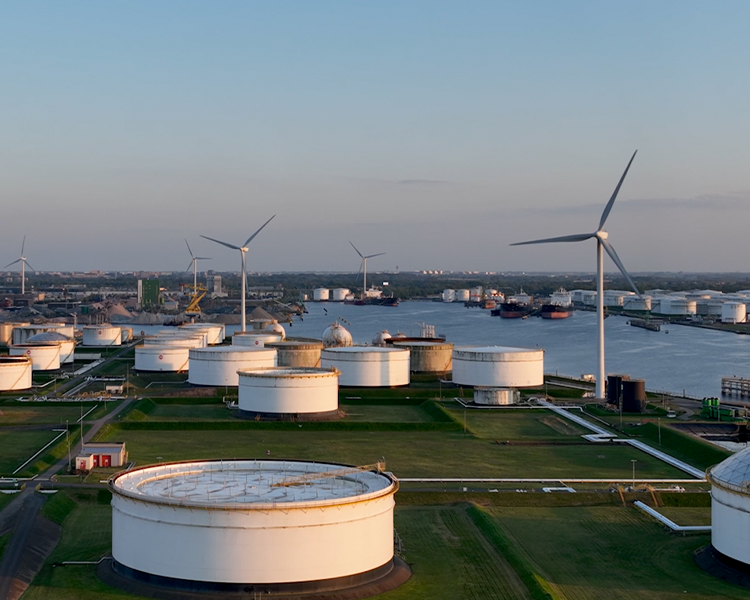


Global listed infrastructure: What every investor should know
As equity markets face mounting inflation risks and stretched valuations, global listed infrastructure is emerging as a compelling allocation—offering investors diversification, inflation protection, and exposure to transformative growth trends.
Watch videoGlobal listed infrastructure: 3 trends changing everything
Global listed infrastructure is undergoing a seismic shift, driven by three converging megatrends—surging power demand, digital transformation, and supply chain reinvention—forces that are unlocking compelling investment opportunities.
Watch videoCohen & Steers Infrastructure Fund NYSE: UTF
With listed infrastructure at its most attractive relative valuations in years, investors are presented with an opportunity to access essential service providers through a discounted, diversified, income-focused strategy.
Watch video