
Issuance trends, structural innovation and stronger fundamentals are expanding the toolkit for active portfolio construction.
KEY TAKEAWAYS
- Greater non-U.S. and nonfinancial issuance has expanded the opportunity set across sectors and issuers while reducing reliance on bank-driven supply.
- Structural innovation has expanded the risk management toolkit, giving active managers greater flexibility to mitigate interest rate sensitivity and extension risk.
- Stronger financial sector fundamentals and a growing presence of high-quality hard-asset issuers have enhanced credit quality, supporting attractive income and total return potential.
1. Preferred securities is an increasingly global and institutional market
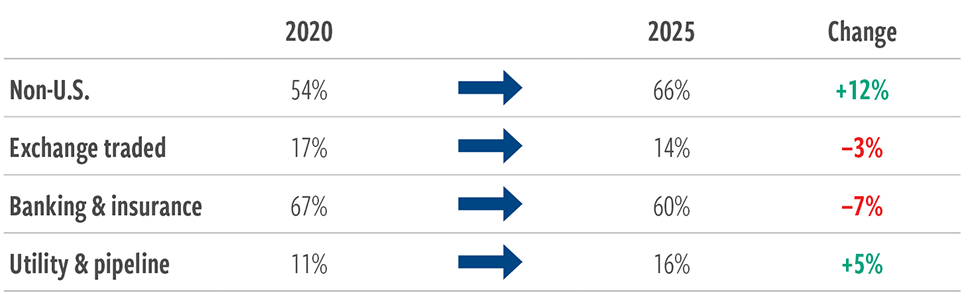
The $1.3 trillion global preferred securities market has evolved beyond its traditional concentration in U.S. financials into a more institutional and diversified asset class. Changes in rating agency methodologies, corporate funding needs and investor demand have broadened the investable universe, creating greater scope to pursue attractive income while also diversifying credit exposure and managing interest rate and extension risk.
An important development has been the growth of European issuance, including euro- and sterling-denominated securities. A larger international investor base can support liquidity, while differences across issuers, structures and markets create additional relative value opportunities.
Issuers have likewise gravitated toward the institutional, over-the-counter (OTC) market and away from the shrinking exchange-traded segment.
These OTC securities typically have fixed-to-reset coupons, unlike the longer-duration, fixed-for-life structures more common in the exchange- traded market. If a fixed-to-reset security remains outstanding after its first call date, its coupon adjusts to a reference rate plus a contractual spread, reducing sensitivity to subsequent rate changes and giving active managers greater flexibility to manage interest rate exposure.
EXHIBIT 1
Preferreds are an increasingly diversified, global market
Geographic, market and sector composition over time
At June 30, 2026. Source: Bloomberg, Cohen & Steers.
2. New issuers and structural innovation broaden portfolio choice
Hybrids and preferreds have long been dominated by banks and insurers, but the market is becoming increasingly diversified at the sector level, both in the U.S. and in Europe. Most large U.S. and European banks are well capitalized and have
satisfied their additional Tier 1 capital needs, limiting the need for significant net new preferred issuance (Exhibit 1). Recent bank supply has therefore been concentrated on refinancing outstanding securities rather than expanding the market. This scarcity can support valuations in bank preferreds, but it also limits the range of opportunities. Against this backdrop, growing global corporate preferred issuance has become an important source of portfolio diversification.
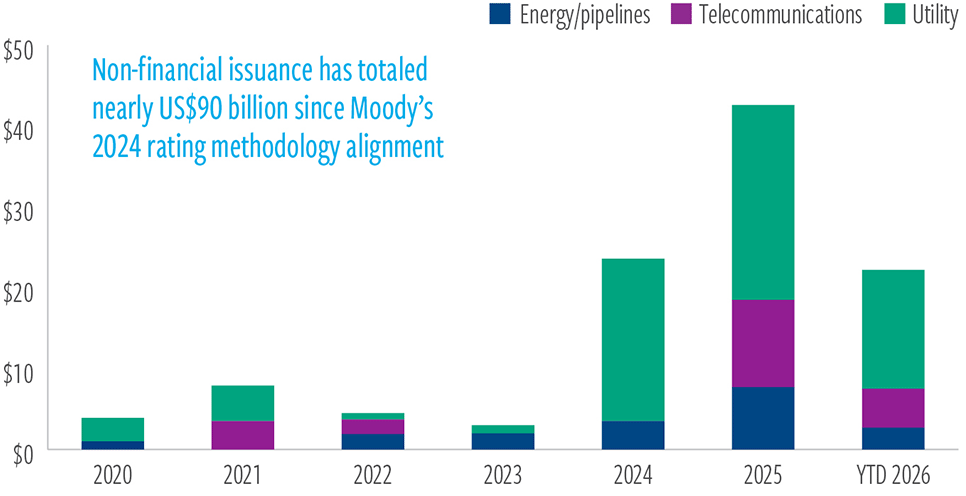
Utilities are raising equity and hybrid capital to fund AI-related investments in power generation and grid infrastructure. This funding need has coincided with a 2024 Moody’s methodology change, which increased the equity credit assigned to qualifying investment-grade corporate hybrids from 25% to 50%, broadly aligning its treatment with those of S&P and Fitch. Because these preferreds are structured as subordinated debt, their interest payments are generally tax deductible, unlike dividends on preferred stock. The combination of equity credit and lower after-tax funding costs has made dated hybrid debt an efficient source of capital, contributing to a substantial increase in non-financial issuance (Exhibit 2).
For investors, this broadens exposure to businesses with regulated, contracted or otherwise durable cash flows, complementing the cyclical risks of financial issuers. These companies also bring capital-spending, leverage and execution risks, making issuer selection especially important.
Many corporate hybrids lose equity credit near a scheduled call date. The resulting decline in capital efficiency can strengthen the issuer’s incentive to refinance, mitigating extension risk. The inclusion of coupon step-ups, primarily in non-U.S. corporate hybrids, further alleviates extension risk. The recent vintage of issues from U.S. utilities has also introduced coupon floors that provide additional income protection if a security remains outstanding. Bank preferreds and CoCos lack the same scheduled decline in equity credit and do not include coupon floors. Their call decisions are therefore more dependent on refinancing economics, reset spreads and interest rates. These structural features can make corporate hybrids particularly valuable, relative to bank perpetuals, in lower-credit-spread environments.
EXHIBIT 2
Fewer financial, more hard asset issues
Gross infrastructure preferred issuance ($ billions)
At June 30, 2026. Source: Bloomberg, Cohen & Steers.
3. Stronger fundamentals reinforce the credit foundation
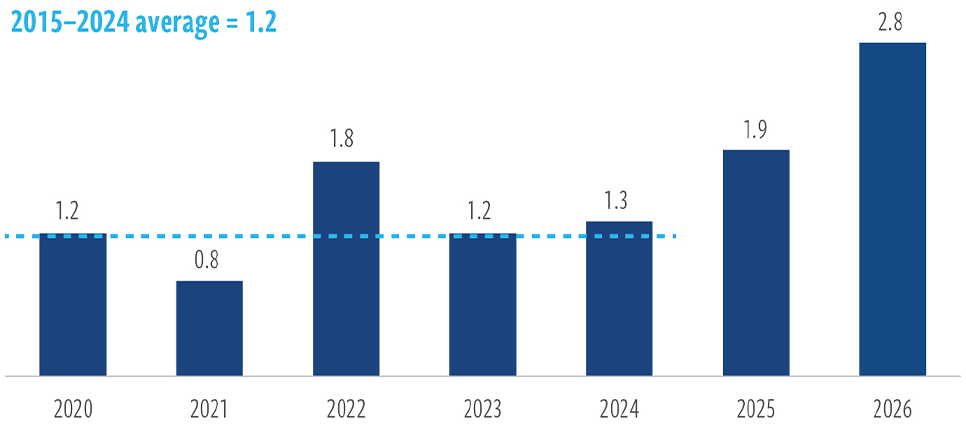
Credit rating trends reinforce this fundamental improvement, with upgrades outpacing downgrades in each year since 2022 (Exhibit 3).
Post-financial-crisis regulation materially increased bank capital and liquidity requirements. Profitability has strengthened, supported by improving net interest margins, solid fee income and low credit costs. Although core capital ratios have moderated from recent peaks as balance sheets have grown and banks have increased capital returns, they remain high by historical standards and well above regulatory minimums. Robust earnings provide additional capacity to absorb a normalization in loan losses.
Insurers also remain well capitalized. Life and annuity providers are benefiting from higher reinvestment yields, which support spread income and investment earnings, while property & casualty insurers have benefited from cumulative pricing actions, disciplined underwriting and higher investment income.
Rising issuance from investment-grade utilities and pipeline companies adds another source of diversification. Regulated, contracted or otherwise durable cash flows can complement the cyclical characteristics of financial issuers.
EXHIBIT 3
Upgrade momentum signals a higher-quality market
Annual credit rating upgrade-downgrade ratio
At June 30, 2026. Source: Bloomberg, Cohen & Steers.
A broader opportunity set increases the value of active management
A broader opportunity set increases the value of active management
Expanded global issuance, a more diverse issuer mix, and more flexible security structures have changed how preferred portfolios can be constructed. Active managers can now allocate across financial and non-financial issuers, currencies, interest rate regimes and call/reset structures, allowing portfolios to diversify credit exposure and manage interest rate and extension risk.
This wider universe also creates additional opportunities for relative value selection, including many outside traditional preferred benchmarks. By combining fundamental credit research with security-level analysis, active managers can identify the issuers and structures best aligned with portfolio objectives, selectively access new issuance, and pursue attractive, durable income across changing market environments
Index definitions and important disclosures
An investor cannot invest directly in an index, and index performance does not reflect the deduction of any fees, expenses or taxes. Index comparisons have limitations, as volatility and other characteristics may differ from a particular investment.
Data quoted represents past performance, which is no guarantee of future results. This material is for informational purposes and reflects prevailing conditions and our judgment as of this date, which are subject to change. There is no guarantee that any market forecast set forth in this presentation will be realized. This material represents an assessment of the market environment at a specific point in time and should not be relied upon as investment advice, does not constitute a recommendation to buy or sell a security or other investment, and is not intended to predict or depict the performance of any investment. This material is not being provided in a fiduciary capacity and is not intended to recommend any investment policy or investment strategy or to take into account the specific objectives or circumstances of any investor. We consider the information in this presentation to be accurate, but we do not represent that it is complete or should be relied upon as the sole source of appropriateness for investment. Please consult with your investment, tax or legal professional regarding your individual circumstances prior to investing.
Risks of investing in preferred securities. An investment in a preferred strategy is subject to investment risk, including the possible loss of the entire principal amount that you invest. The value of these securities, like other investments, may move up or down, sometimes rapidly and unpredictably. Our preferred strategies may invest in below-investment-grade securities and unrated securities judged to be below investment grade by the Advisor. Below- investment-grade securities or equivalent unrated securities generally involve greater volatility of price and risk of loss of income and principal, and they may be more susceptible to real or perceived adverse economic and competitive industry conditions than higher-grade securities. The strategies’ benchmarks do not contain below-investment-grade securities.
Contingent capital securities (CoCos). CoCos are debt or preferred securities with loss absorption characteristics built into the terms of the security, for example, a mandatory conversion into common stock of the issuer under certain circumstances, such as the issuer’s capital ratio falling below a certain level. Since the common stock of the issuer may not pay a dividend, investors in these instruments could experience a reduced income rate, potentially to zero, and conversion would deepen the subordination of the investor, hence worsening the investor’s standing in a bankruptcy. Some CoCos provide for a reduction in the value or principal amount of the security under such circumstances. In addition, most CoCos are considered to be high-yield securities and are therefore subject to the risks of investing in below-investment-grade securities.
Duration risk. Duration is a mathematical calculation of the average life of a fixed income or preferred security that serves as a measure of the security’s price risk to changes in interest rates (or yields). Securities with longer durations tend to be more sensitive to interest rate (or yield) changes than securities with shorter durations. Duration differs from maturity in that it considers potential changes to interest rates, and a security’s coupon payments, yield, price and par value and call features, in addition to the amount of time until the security matures. Various techniques may be used
Cohen & Steers Capital Management, Inc. (Cohen & Steers) is a U.S. registered investment advisory firm that provides investment management services to corporate retirement, public and union retirement plans, endowments, foundations and mutual funds. Cohen & Steers Asia Limited is authorized and regulated by the Securities and Futures Commission of Hong Kong (ALZ367). Cohen & Steers Japan Limited is a registered financial instruments operator (investment advisory and agency business and discretionary investment management business with the Financial Services Agency of Japan and the Kanto Local Finance Bureau No. 3157) and is a member of the Japan Investment Advisers Association. Cohen & Steers UK Limited is authorized and regulated by the Financial Conduct Authority (FRN458459). Cohen & Steers Ireland Limited is regulated by the Central Bank of Ireland (No.C188319). Cohen & Steers Singapore Private Limited is a private company limited by shares in the Republic of Singapore.
For recipients in the Middle East: This document is for informational purposes only. It does not constitute or form part of any marketing initiative or any offer to issue or sell (or any solicitation of any offer to subscribe or purchase) any products, strategies or other services, nor shall it or the fact of its distribution form the basis of, or be relied on in connection with, any contract resulting therefrom. In the event that the recipient of this document wishes to receive further information with regard to any products, strategies or other services, it shall specifically request the same in writing from us.