
We believe a compelling buying opportunity for hybrid credit exists today.
1. Access to AI-driven growth via electricity demand
Electric utilities are a growing opportunity set, with AI-driven growth translating into higher regulated capex, increased hybrid issuance, and improving fundamentals for utility hybrids. Capex growth is expected to accelerate from ~6% to ~9% between 2025 and 2029.
Utility aggregate rate base growth (US$ B)
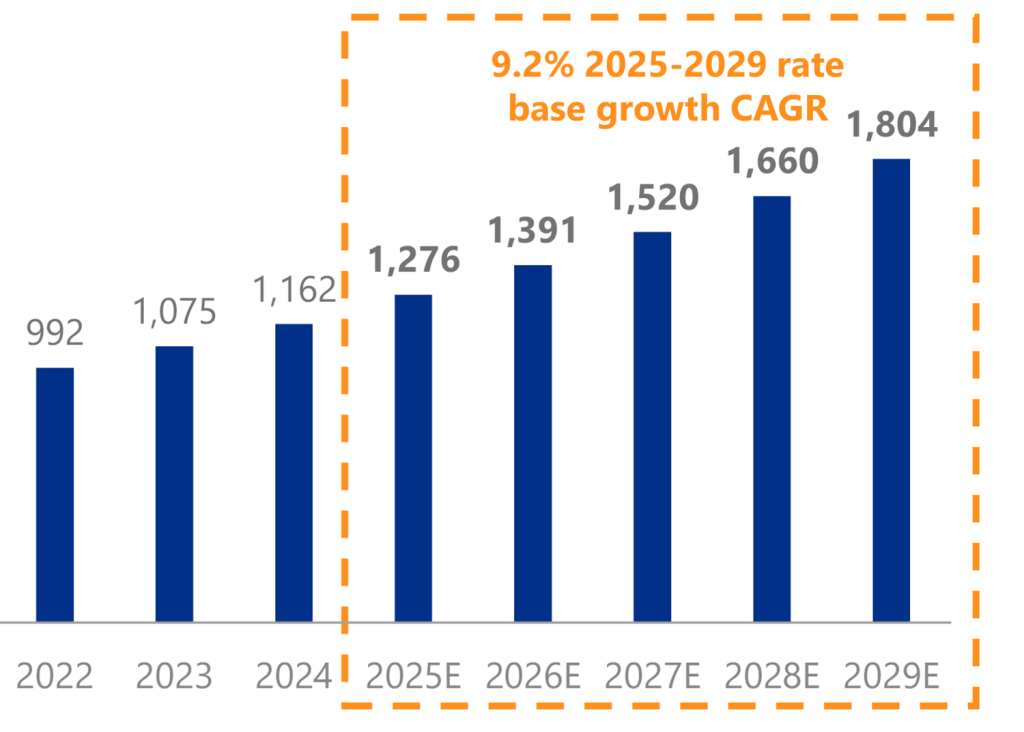
Source: Barclays. Cross Asset Research: Data Center Capex Rewiring Utility Funding: CDS Implications of More Converts, Hybrids, December 2025.
2. In a tight credit spread environment, hybrids provide additional income over investment-grade and high yield
Relative to investment-grade and high yield corporate bonds, hybrid credit continues to command a premium for a similar credit rating: 64 basis points (bps) for BBB- equivalent debt and 4 bps for BB-equivalent.
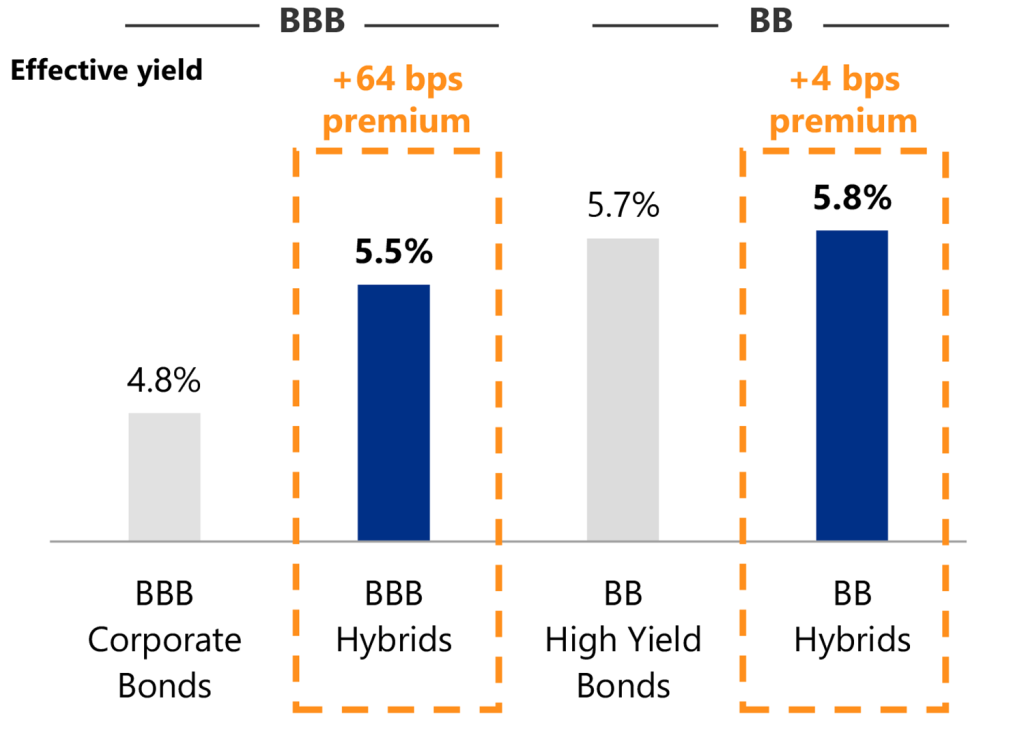
At 30 June 2026. Source: ICE.
BBB Corporate Bonds: ICE BofA BBB Global Corporate Index. BBB & BB Hybrids: ICE Large Cap Capital Securities Index. BB High Yield Bonds: BB High Yield Bonds: ICE BofA Global High Yield Index.
3. Historically strong fundamentals for banks and insurance
Fundamentals across hybrid issuers— including banks, insurance companies and utilities—remain strong. For example, global systemically important banks continue to demonstrate robust capital levels, profitability and asset quality.
Core capital ratios of major U.S. & European banks
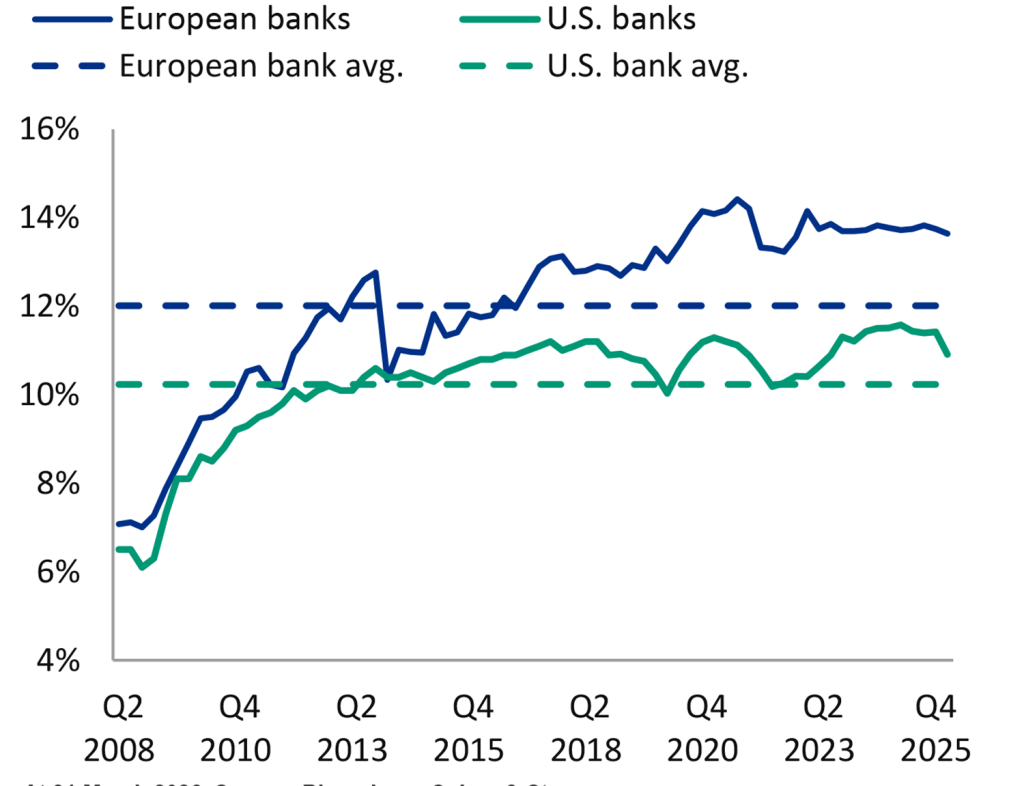
At 31 March 2026. Source: Bloomberg, Cohen & Steers.
Core capital ratio is the ratio of core (common equity) capital to total risk-weighted assets. Banks must meet a minimum core capital requirement as dictated by local banking laws and regulations. Higher core capital ratios have helped to strengthen banks’ balance sheets and to improve their credit quality. European core capital ratios are based on the following major banks: HSBC Holdings Plc, Deutsche Bank AG, BNP Paribas SA, Crédit Agricole SA, Barclays Plc, Société Générale SA, Banco Santander SA, NatWest Group plc, UBS AG, UniCredit SpA, Lloyds Banking Group Plc, Intesa Sanpaolo SpA, Commerzbank AG and Banco Bilbao Vizcaya Argentaria, SA. U.S. core capital ratios based on the following major banks: Bank of America, JPMorgan Chase & Co., Citigroup Inc., Wells Fargo & Company, U.S. Bancorp, PNC Financial Services Group, Inc., SunTrust Banks, Inc., BB&T Corporation, Regions Financial Corporation, KeyCorp, M&T Bank Corporation, Comerica Incorporated, Synovus Financial Corp. and First Horizon National Corporation. The mention of specific companies is not a recommendation or solicitation to buy, sell or hold any particular security and should not be relied upon as investment advice.
Past performance is no guarantee of future results. The information presented above does not reflect the performance of any fund or other account managed or serviced by Cohen & Steers, and there is no guarantee that investors will experience the type of performance reflected above. There is no guarantee that any historical trend illustrated above will be repeated in the future or any way to know in advance when such a trend might begin. An investor cannot invest directly in an index and index performance does not reflect the deduction of any fees, expenses or taxes. There is no guarantee that any market forecast set forth will be realized.