

Recent market action is beginning to reflect improving fundamentals, a move we have anticipated for some time. Towers’ critical role in the digital economy supports the long-term opportunity.
KEY TAKEAWAYS
- The towers recovery is underway
Tower REITs gained 18.6% in October through the 23rd as headwinds faded, with an added boost from reports that SpaceX is considering a terrestrial network that could increase leasing demand. - Towers and satellites are complementary
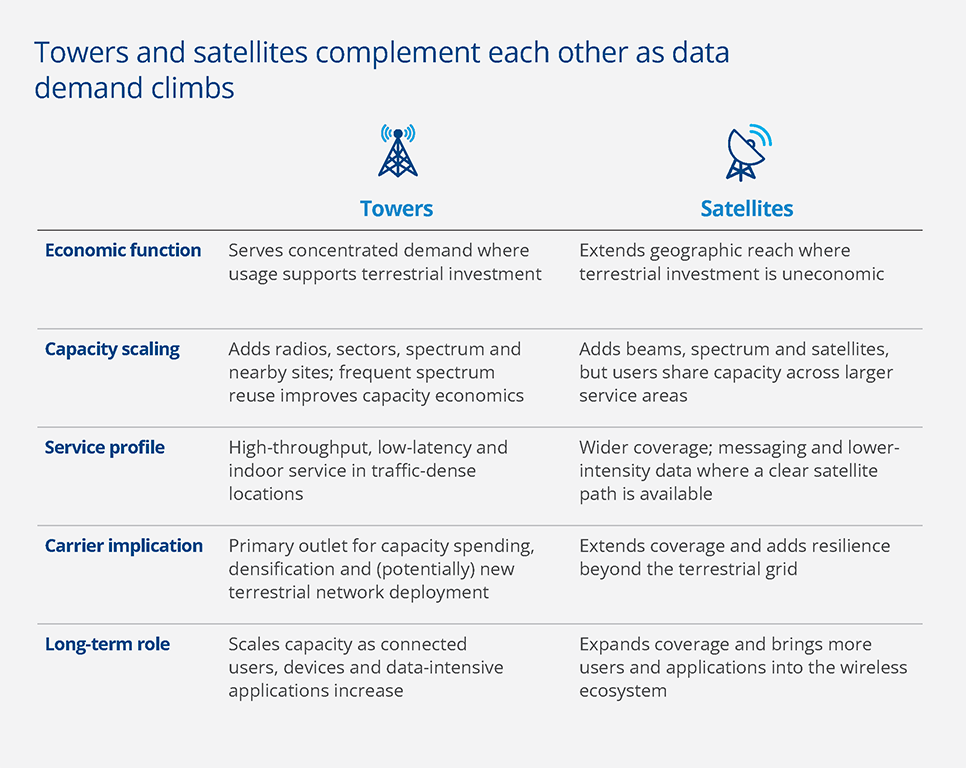
Towers are critical infrastructure supporting a more connected world. Rather than competing, towers and satellites serve distinct needs: towers deliver capacity; satellites extend coverage. - Improving fundamentals support valuation upside
Towers still trade at a 6.2x price- to-cash-flow discount to the broader REIT market. Expected improving cash flow could narrow that gap, with renewed carrier investment providing another potential catalyst.
After declining 10.6% year to date through September 30, tower stocks gained 18.6% in October through the 23rd, bringing year-to-date returns back into positive territory (Exhibit 1). That reversal is consistent with a fundamental recovery we have been expecting—and publicly forecasting—for some time.
EXHIBIT 1
Towers October rally pushes performance into positive territory
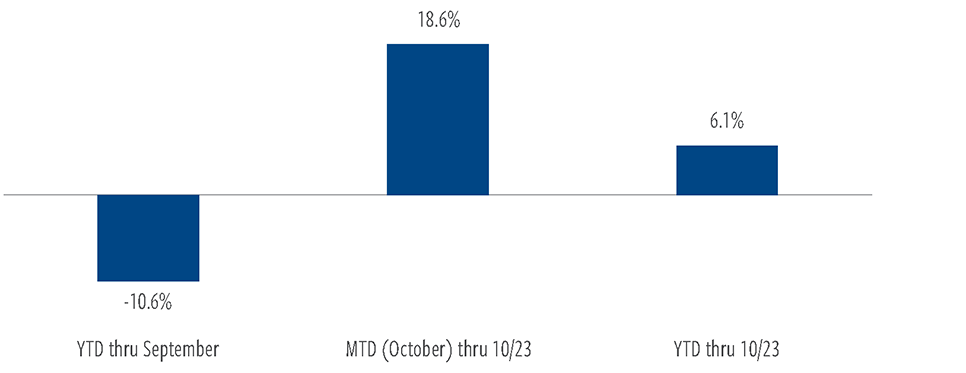
At October 23, 2026. Source: Bloomberg. Based on FTSE Nareit All Equity REITs Index.
Past results are not indicative of future results. Performance presented above does not reflect the performance of any fund or account managed or serviced by Cohen & Steers, and there is no guarantee that investors will experience the type of performance reflected
Our conviction has been grounded in the essential role towers play in today’s connected world. Towers are critical infrastructure connecting the computing power of data centers and the cloud with consumers and businesses. As mobile video, fixed wireless, connected devices and AI- enabled applications drive greater data consumption, wireless networks need the capacity towers provide.
Now the fundamental and market stories are beginning to converge. We forecast cash flow growth approaching 5% in 2027 and more than 6% in 2028 as previous headwinds diminish (Exhibit 2).
EXHIBIT 2
We anticipate stronger cash flows as headwinds fade
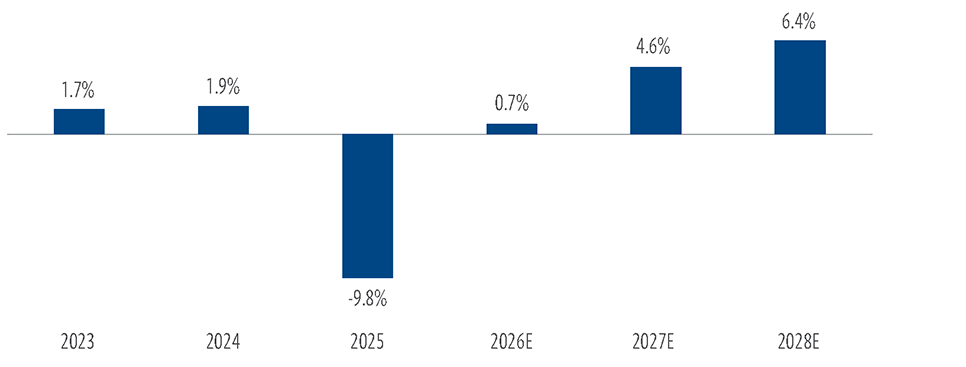
At October 23, 2026. Source: Cohen & Steers estimates, Bloomberg.
There is no guarantee that any market forecast will be realized.
And a potential new catalyst is emerging: Reports that SpaceX is considering a sizable terrestrial network suggest that satellite connectivity could ultimately create additional tower demand rather than displace it. That news drove a one-day climb of 5.2% in tower REITs on October 23.
Durable secular demand and fading headwinds were already driving a recovery in cash flow growth. The potential emergence of a new large-scale carrier should only accelerate it. Valuations do not yet reflect this possibility, setting the stage for a meaningful re-rating.
The road to recovery in cash flow growth
Share price weakness from 2021 through 2025 reflected an unusual concentration of headwinds that weighed on cash flow growth. The Sprint network consolidation and subsequent DISH lease cancellations removed duplicate equipment from tower sites and pressured rental income. At the same time, carrier investment slowed after the initial 5G buildout, limiting new leasing available to offset those cancellations. Asset sales reduced the contribution from income-producing assets, while higher interest rates increased refinancing costs and compressed valuations.
Those headwinds have faded. The major Sprint and DISH lease cancellations were one-time events and are now substantially reflected in results. No remaining tenant outside the three national carriers represents more than 1% of U.S. tower revenue, reducing the risk of another comparable cancellation cycle. The effects of asset sales and the most significant refinancing resets are also increasingly priced into in the earnings base.
As these finite drags roll off, cash flow growth has a clearer path to recovery, and that recovery does not depend on a sharp near-term acceleration in carrier spending. Renewed carrier investment would only provide additional upside.
We believe the rebound we’re seeing now is consistent with growing recognition of improving fundamentals that had been developing beneath the surface, even as tower shares continued to struggle. Importantly, the fundamental recovery does not require a new source of carrier demand. The potential emergence of another large-scale terrestrial carrier would represent incremental upside to an investment case already supported by recovering cash flow growth and secular demand for network capacity.
EXHIBIT 3
Global mobile data use continues to climb
(Exabytes per month(a))
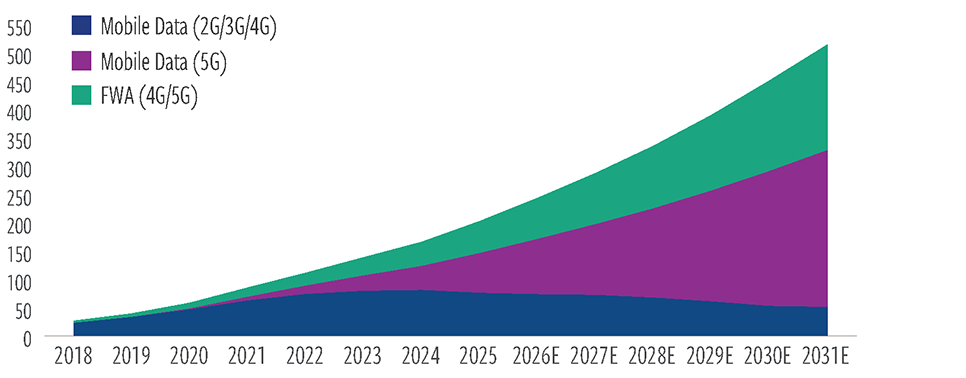
At June 30, 2026, unless otherwise stated. Source: Ericsson Mobility Report, Cohen & Steers estimates.
Data quoted represents past performance, which is no guarantee of future results. There is no guarantee that any market forecast will be realized.
(a) One exabyte equals one billion gigabytes.
A perceived threat could become a new growth catalyst
Some investors have viewed satellite connectivity as a potential threat to towers. We see the technologies as serving complementary functions.
Satellites extend coverage; towers provide capacity. Satellites can efficiently bring connectivity to remote and sparsely populated areas where terrestrial deployment is less economic. Towers provide the dense, high-capacity infrastructure required where data usage is concentrated, particularly for indoor service and increasingly data-intensive applications.
Recent reports that SpaceX is considering building a sizable terrestrial network reinforce the potential connection between the two forms of infrastructure. The ultimate size and scope of any SpaceX deployment remain uncertain. But a meaningful terrestrial build could create something the U.S. tower industry has lacked: an additional large-scale source of carrier demand.
The precise number of sites is less important to the investment case than the potential emergence of another substantial user of macro tower infrastructure. Our scenario analysis indicates that a sizable new network build could add approximately 100–200 basis points to current net organic revenue growth over a multi-year deployment period, without requiring any acceleration in activity from the three incumbent national carriers.
That incremental revenue could have an outsized effect on cash flow, because much of it would leverage infrastructure already in place. And any competitive response from incumbent carriers seeking to strengthen their own networks could provide an additional source of leasing activity.
Once again, this possibility represents upside to our existing outlook, which is already positive. Our expectation for recovering tower cash flow growth does not depend on a SpaceX build or a significant acceleration in investment from the existing national carriers.
Valuations offer additional potential
Despite the recent rebound, tower valuations remain substantially lower than earlier in the cycle: Shares currently trade at a 4.1x discount to the broader REIT market on price-to-cash-flow multiples, compared with a 6.6x premium in 2020 (Exhibit 4).
We believe continued improvement in cash flow growth could narrow that gap. This creates the potential for returns from both underlying earnings growth and valuation re-rating, with renewed carrier investment providing another possible source of upside.
What the market once viewed as a disruption risk could ultimately become another catalyst for an asset class whose fundamental recovery is already underway.
EXHIBIT 4
Tower valuations have overcorrected
Tower cash flow multiple spread to REITs(a)
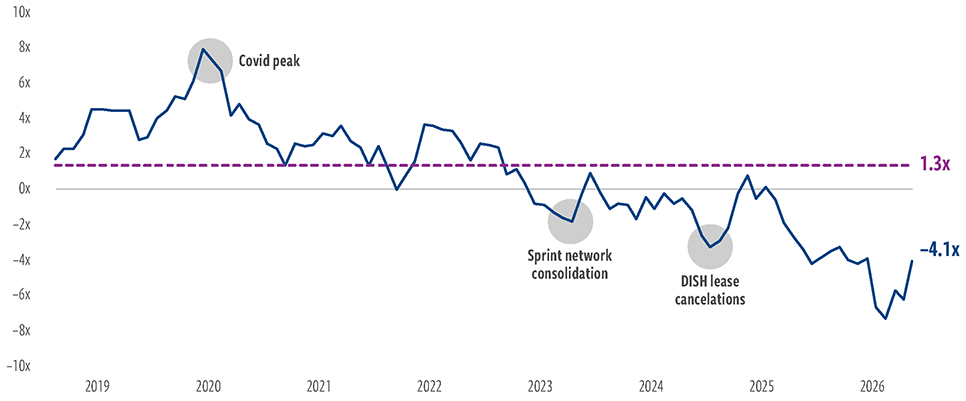
At October 26, 2026. Source: Cohen & Steers, Bloomberg.
(a) Cash flow multiples represented by FAD multiples.
ABOUT THE AUTHORS

Alec Overby, CFA, Vice President, is a real estate securities managing analyst covering the office and regional mall sectors.
An investor cannot invest directly in an index, and index performance does not reflect the deduction of any fees, expenses or taxes. Index comparisons have limitations, as volatility and other characteristics may differ from a particular investment.
FTSE Nareit All Equity REITs Index contains all tax-qualified REITs with more than 50% of total assets in qualifying real estate assets other than mortgages secured by real property that also meet minimum size and liquidity criteria.
Data quoted represents past performance, which is no guarantee of future results. This material is for informational purposes and reflects prevailing conditions and our judgment as of this date, which are subject to change. There is no guarantee that any market forecast will be realized. This material represents an assessment of the market environment at a specific point in time and should not be relied upon as investment advice, does not constitute a recommendation to buy or sell a security or other investment, and is not intended to predict or depict the performance of any investment. This material is not being provided in a fiduciary capacity and is not intended to recommend any investment policy or investment strategy or to take into account the specific objectives or circumstances of any investor. Index or market information presented does not reflect the performance of any fund or account managed or serviced by Cohen & Steers, and there is no guarantee that investors will experience the type of performance reflected. We consider the information to be accurate, but we do not represent that it is complete or should be relied upon as the sole source of appropriateness for investment. Please consult with your investment, tax or legal professional regarding your individual circumstances prior to investing.
Important Risk Considerations: Investing involves risk, including entire loss of capital invested. There can be no assurance that the investment strategy will meet its investment objectives. Risks of investing in real estate securities are similar to those associated with direct investments in real estate, including falling property values due to increasing vacancies or declining rents resulting from economic, legal, political or technological developments, lack of liquidity, limited diversification and sensitivity to certain economic factors such as interest rate changes and market recessions. Concentrated strategies may present a higher degree of risk.
Cohen & Steers Capital Management, Inc. (Cohen & Steers) is a U.S. registered investment advisory firm that provides investment management services to corporate retirement, public and union retirement plans, endowments, foundations and mutual funds. Cohen & Steers Asia Limited is authorized and regulated by the Securities and Futures Commission of Hong Kong (ALZ367). Cohen & Steers Japan Limited is a registered financial instruments operator (investment advisory and agency business and discretionary investment management business with the Financial Services Agency of Japan and the Kanto Local Finance Bureau No. 3157) and is a member of the Japan Investment Advisers Association. Cohen & Steers UK Limited is authorized and regulated by the Financial Conduct Authority (FRN458459). Cohen & Steers Ireland Limited is regulated by the Central Bank of Ireland (No.C188319). Cohen & Steers Singapore Private Limited is a private company limited by shares in the Republic of Singapore.