

As equity markets face mounting inflation risks and stretched valuations, global listed infrastructure is emerging as a compelling allocation—offering investors diversification, inflation protection, and exposure to transformative growth trends.
KEY TAKEAWAYS
- Infrastructure companies deliver stable, predictable cash flows from essential services. Historically, they have matched broad equity market returns while cushioning downside risk—declining less than 70% as much as global equities during market downturns.
- With minimal overlap with global equity indexes, infrastructure provides access to underrepresented sectors. Many companies have inflation-linked pricing mechanisms, enabling them to pass rising costs—whether from inflation, interest rates, or tariffs—on to customers.
- We believe infrastructure is positioned to benefit from powerful long-term trends: rising energy demand, the digital transformation of the economy and deglobalization shifting supply chain—all fueling investment across the asset class.
Global listed infrastructure is increasingly attractive to investors seeking diversification, inflation protection and long-term growth.
It spans four main categories: utilities, including electric, water and gas companies; communications, like satellites, data centers and cell towers; transportation assets like railways, marine ports, airports and toll roads; and finally midstream energy, such as energy pipeline and storage companies.
These assets are the backbone of the global economy, with an investment universe of roughly $6 trillion by market cap.
Why should investors care about this asset class? We see three key reasons:
First is return consistency. Infrastructure companies typically generate stable, predictable cash flows from essential services, such as power for our homes and businesses in the case of electric utilities. Infrastructure historically has delivered returns competitive with the broad equity market. But when global stock markets decline, infrastructure experiences less than 70% of the decline, on average. That’s attractive downside risk mitigation, especially in a slowing growth environment.
Second, diversification. There is very little overlap between global equity indexes and the listed infrastructure universe of companies. Infrastructure represents just 4% of global stock indexes, giving investors access to subsectors and investment themes typically under-represented in broad equity market allocations.
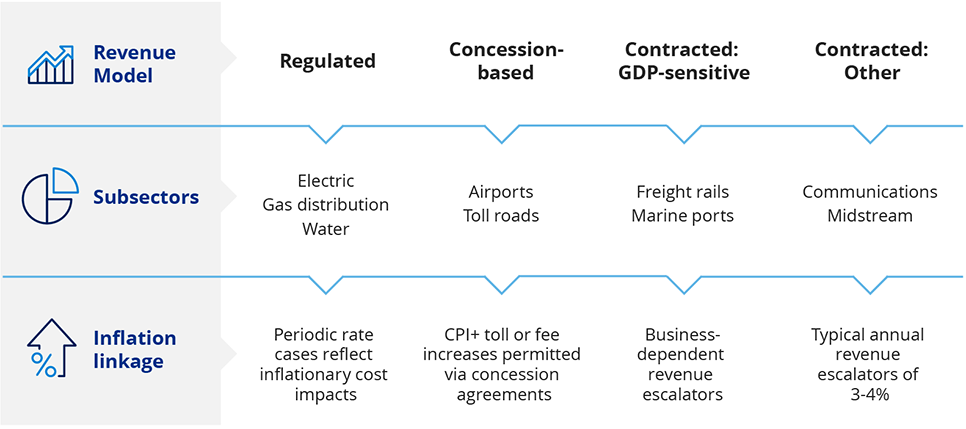
In addition to the downside risk mitigation I mentioned, which is a distinguishing diversifying feature, infrastructure offers higher inflation sensitivity than stocks or bonds. These companies often have inflation-linked pricing built into their revenue models, allowing them to adjust contract prices. For instance, airport and toll road operators typically have agreements that allow service rate hikes based on fixed amounts above the inflation rate. The catalyst for higher costs in this example was inflation, but the same can be said for higher costs due to rising interest rates or tariffs. So there are mechanisms built into the contract structure for most infrastructure businesses that allow them to pass higher costs, whether from inflation, rates or tariffs, on to customers.
Finally, the asset class offers substantial growth potential. In developed economies, there is a growing need to upgrade existing, aging critical infrastructure. Emerging economies need to build new infrastructure to address population growth and urbanization. Add to these three powerful secular growth trends that are accelerating infrastructure spending.
Pricing mechanisms drive inflation sensitivity
First, rising power demand and decarbonization: AI, electric vehicles, and data processing are fueling unprecedented demand, while renewables, now cost-competitive, are set to grow from 10% to nearly 30% of global power generation by 2040, benefiting utilities and midstream energy. Second, digital transformation: surging mobile data use, powered by 5G and AI, boosts opportunities for cell towers and data centers. Third, deglobalization: nearshoring and supply chain shifts make freight railways, ports, and airports more valuable.
As investors contend with inflation risks, as well as sky-high equity valuations in the broad market, they’re seeking alternatives to traditional stocks and bonds. Global listed infrastructure is a diversifier, offering access to companies with inflation-linked stable cash flows from essential services that often remain in demand even in periods of economic downturns. Furthermore, the asset class offers exposure to transformative secular growth trends that we’re excited about. Infrastructure isn’t just an investment—it’s a stake in our ever-evolving modern economy.
ABOUT THE AUTHORS

Michelle Butler, Senior Vice President, is a Portfolio Specialist for Cohen & Steers’ Real Assets, Global Listed Infrastructure, Natural Resource Equity and Future of Energy strategies.
Data quoted represents past performance, which is no guarantee of future results. The information presented does not reflect the performance of any fund or account managed or serviced by Cohen & Steers, and there is no guarantee that investors will experience the type of performance reflected. There is no guarantee that any market forecast set forth in this video will be realized. There is no guarantee that any historical trend referenced herein will be repeated in the future, and there is no way to predict precisely when such a trend will begin. The mention of specific securities is not a recommendation or solicitation to buy, sell or hold any particular security and should not be relied upon as investment advice.
This video is for informational purposes and reflects prevailing conditions and our judgment as of August 15, 2025, which are subject to change. This material should not be relied upon as investment advice, does not constitute a recommendation to buy or sell a security or other investment and is not intended to predict or depict performance of any investment. This material is not being provided in a fiduciary capacity and is not intended to recommend any investment policy or investment strategy or take into account the specific objectives or circumstances of any investor. We consider the information in this video to be accurate, but we do not represent that it is complete or should be relied upon as the sole source of appropriateness for investment. Please consult with your investment, tax or legal professional regarding your individual circumstances prior to investing.
Risks of investing in global infrastructure securities. Infrastructure issuers may be subject to regulation by various governmental authorities and may also be affected by governmental regulation of rates charged to customers, operational or other mishaps, tariffs, and changes in tax laws, regulatory policies, and accounting standards. Foreign securities involve special risks, including currency fluctuation and lower liquidity. Some global securities may represent small and medium-sized companies, which may be more susceptible to price volatility than larger companies. No representation or warranty is made as to the efficacy of any particular strategy or fund or to the actual returns that may be achieved.
Cohen & Steers Capital Management, Inc. (Cohen & Steers) is a U.S. registered investment advisory firm that provides investment management services to corporate retirement, public and union retirement plans, endowments, foundations and mutual funds. Cohen & Steers Asia Limited is authorized and regulated by the Securities and Futures Commission of Hong Kong (ALZ367). Cohen & Steers Japan Limited is a registered financial instruments operator (investment advisory and agency business and discretionary investment management business with the Financial Services Agency of Japan and the Kanto Local Finance Bureau No. 3157) and is a member of the Japan Investment Advisers Association. Cohen & Steers UK Limited is authorized and regulated by the Financial Conduct Authority (FRN458459). Cohen & Steers Ireland Limited is regulated by the Central Bank of Ireland (No.C188319). Cohen & Steers Singapore Private Limited is a private company limited by shares in the Republic of Singapore.
For recipients in the Middle East: This document is for informational purposes only. It does not constitute or form part of any marketing initiative or any offer to issue or sell (or any solicitation of any offer to subscribe or purchase) any products, strategies or other services, nor shall it or the fact of its distribution form the basis of, or be relied on in connection with, any contract resulting therefrom. In the event that the recipient of this document wishes to receive further information with regard to any products, strategies or other services, it shall specifically request the same in writing from us.
UBS Securities LLC is acting as dealer manager for the rights offering. In the U.S., securities underwriting, trading, and brokerage activities and M&A advisory activities are provided by UBS Securities LLC, a registered broker/dealer that is a wholly owned subsidiary of UBS AG, a member of the New York Stock Exchange and other principal exchanges, and a member of Securities Investor Protection Corporation.