

The first half of 2026 reinforced why we believe listed infrastructure remains one of the most compelling investment opportunities in today’s market.
KEY TAKEAWAYS:
- Listed infrastructure delivered a strong first half, returning 11.3% through July, supported by resilient essential-asset demand and investor interest in hard-asset, low-obsolescence allocations.
- Midstream energy, electric utilities, LNG infrastructure, railways and ports led, while airports, toll roads and communications lagged due to factors including rates, geopolitical disruption and concerns about satellite competition.
- The long-term outlook remains constructive, driven by digitalization, AI-related power demand, grid reliability needs and supply-chain realignment, but dispersion across sectors reinforces the case for active management.
Infrastructure returned 11.3% through July, outperforming many traditional asset classes while continuing to demonstrate the resilience investors have historically sought from essential assets.
That was especially true in the first quarter when global equity markets declined amid rising uncertainty, and government bond yields moved higher, limiting the offset bonds have historically provided during equity drawdowns.
Further, investors have gravitated towards so-called HALO assets (hard asset, low obsolescence), while questioning the sustainability of the technology sector’s ascent given mounting questions regarding AI return on investment and hyperscaler funding.
Midstream energy was among the strongest performing subsectors, with oil-focused operators benefiting from expectations of rising energy production and infrastructure demand given the surge in crude prices.
Electric utilities delivered strong returns amid growing AI-driven energy demand.
Liquified natural gas-focused companies also gained, supported by a sharp rise in European gas prices.
Railways were supported by a seeming turn in the freight cycle, characterized by very strong freight volumes, while marine ports benefited from cargo re-routing.
In terms of laggards, airports lagged due to travel disruptions from the Iran war and higher jet fuel prices.
Toll roads also lagged, as rising interest rates weighed on this defensive but rate-sensitive segment.
The weakest performer was communications, and I’d like to spend a moment here. There were two things weighing on the sector.
First, higher interest rates.
Second, investors have questioned whether low earth orbit satellite systems—such as Starlink—could become material competition to towers, lessening the demand for terrestrial infrastructure.
Here’s our view: Mobile data demand continues to grow as consumers spend more time on connected devices and AI-powered applications drive increasingly data-intensive activity.
Towers supported by growing mobile data
Global mobile data traffic forecast – Exabytes per Month(1)
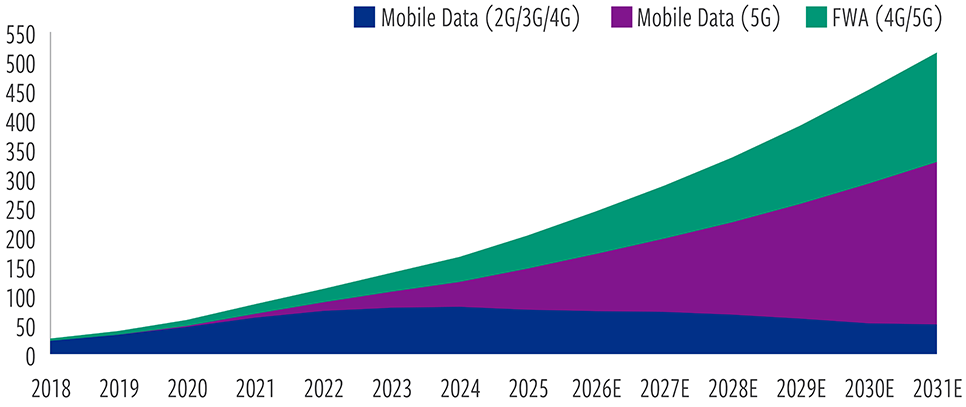
At June 30, 2026. Ericsson Mobility Report and Cohen & Steers estimates. Data quoted represents past performance, which is no guarantee of future results.
(1) One exabyte equals one billion gigabytes.
At the same time, valuations have reset significantly and earnings growth is expected to reaccelerate over the next several years.
And while satellite connectivity will continue to expand, we believe it complements, rather than replaces, terrestrial networks.
We believe the telecommunications networks of the future will combine space-based and terrestrial networks, with attractive investment opportunities existing in both.
Looking ahead, we believe the investment case for global listed infrastructure remains strong.
Digital transformation of economies, supply-chain realignment and rising energy demand continue to support infrastructure investment.
We also believe the macro backdrop remains supportive.
Economic activity has remained resilient, supporting infrastructure demand, while monetary and fiscal policy continue to provide a constructive backdrop for growth.
We also believe valuations remain attractive relative to broader equities despite strong first- half performance.
Attractive entry point for infrastructure
Infrastructure currently trading at a significant discount to global equities– December 2010–June 2026
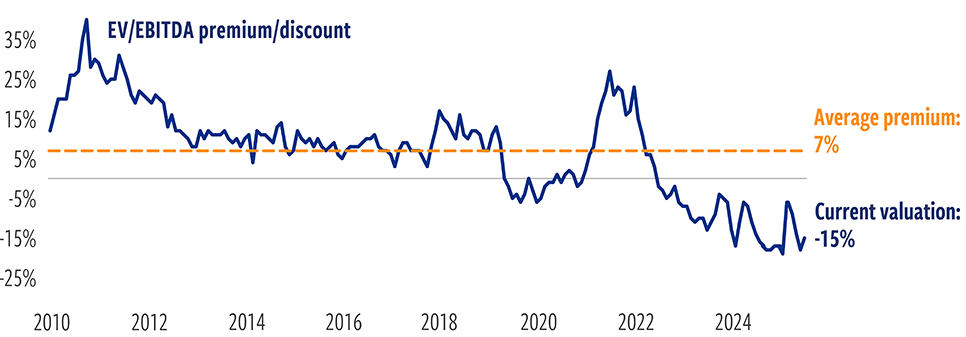
At June 30, 2026. Source: MSCI, FTSE, FactSet and Cohen & Steers.
We’re particularly constructive on the long-term outlook for power demand.
AI and broader electrification will drive 3-5%
U.S. power demand growth rate through 2030
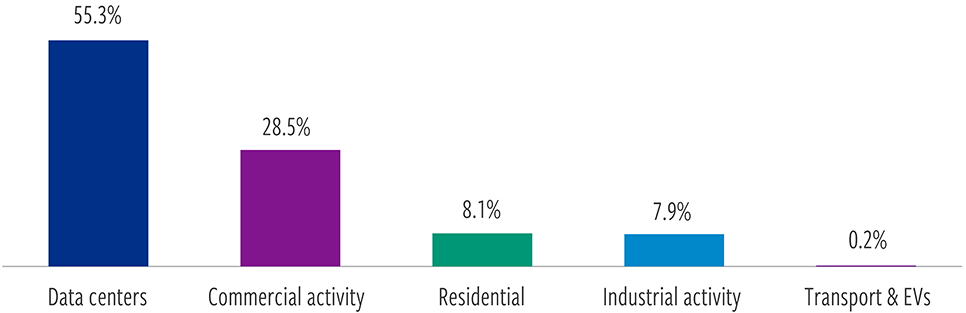
At June 30, 2026. Source: Cohen & Steers. There is no guarantee that any market forecast set forth in this presentation will be realized.
AI adoption, data center growth and the need for greater grid reliability are driving significant investment needs across electric utilities, natural gas infrastructure and related energy networks.
While much of the focus has been on power demand, the continued digital transformation of the economy is also creating opportunities.
But we’re also mindful that inflation risks, trade policy, and regulatory decisions, particularly amid growing concerns about affordability, can create meaningful differences across sectors and companies.
Ultimately, we believe this is an environment that rewards active management.
ABOUT THE AUTHORS

Benjamin Morton, Executive Vice President, is Head of Global Infrastructure and a senior portfolio manager for Cohen & Steers’ infrastructure portfolios, including those focused on master limited partnerships.
Index definitions and important disclosures
Infrastructure represented by the FTSE Global Core 50/50 Net Tax Index.
Data quoted represents past performance, which is no guarantee of future results. The views and opinions presented are as of the date of publication and are subject to change. There is no guarantee that any market forecast set forth will be realized. This material represents an assessment of the market environment at a specific point in time and should not be relied upon as investment advice, does not constitute a recommendation to buy or sell a security or other investment and is not intended to predict or depict performance of any investment. This material is not being provided in a fiduciary capacity and is not intended to recommend any investment policy or investment strategy or to account for the specific objectives or circumstances of any investor. We consider the information to be accurate, but we do not represent that it is complete or should be relied upon as the sole source of appropriateness for investment. Cohen & Steers does not provide investment, tax or legal advice. Please consult with your investment, tax or legal professional regarding your individual circumstances prior to investing.
Risks of Investing in global infrastructure securities. Infrastructure issuers may be subject to regulation by various governmental authorities and may also be affected by governmental regulation of rates charged to customers, operational or other mishaps, tariffs, and changes in tax laws, regulatory policies, and accounting standards. Foreign securities involve special risks, including currency fluctuation and lower liquidity. Some global securities may represent small and medium-sized companies, which may be more susceptible to price volatility than larger companies. No representation or warranty is made as to the efficacy of any particular strategy or fund or to the actual returns that may be achieved. No representation or warranty is made as to the efficacy of any particular strategy or fund or the actual returns that may be achieved.
Cohen & Steers Capital Management, Inc. (Cohen & Steers) is a U.S. registered investment advisory firm that provides investment management services to corporate retirement, public and union retirement plans, endowments, foundations and mutual funds. Cohen & Steers U.S. registered open-end funds are distributed by Cohen & Steers Securities, LLC and are only available to U.S. residents. Cohen & Steers Asia Limited is authorized and regulated by the Securities and Futures Commission of Hong Kong (ALZ367).
Cohen & Steers Japan Limited is a registered financial instruments operator (investment advisory and agency business and discretionary investment management business with the Financial Services Agency of Japan and the Kanto Local Finance Bureau No. 3157) and is a member of the Japan Investment Advisers Association. Cohen & Steers UK Limited is authorized and regulated by the Financial Conduct Authority (FRN458459). Cohen & Steers Ireland Limited is regulated by the Central Bank of Ireland (No. C188319). Cohen & Steers Singapore Limited is a private company limited by shares in the Republic of Singapore.
For recipients in the Middle East: This document is for information purposes only. It does not constitute or form part of any marketing initiative, any offer to issue or sell, or any solicitation of any offer to subscribe or purchase, any products, strategies or other services nor shall it or the fact of its distribution form the basis of, or be relied on in connection with, any contract resulting therefrom. In the event that the recipient of this document wishes to receive further information with regard to any products, strategies other services, it shall specifically request the same in writing from us.