
Strong fundamentals, improving credit quality and attractive yields underpin the case for preferreds today.
When investors see yields of 6% to 8%, they often assume they’re taking significant credit risk. But it’s generally a different story in today’s preferred securities market.
Many preferred securities are issued by some of the strongest companies in the global economy, including banks, insurers and utilities. These sectors represent the core of the preferreds market and have entered this period from a position of strength.
Strict capital requirements since the global financial crisis mean core capital ratios for banks and insurance companies are near historically high levels, providing a significant cushion against future losses while supporting credit quality. Strong earnings expectations and profitability further reinforce issuer fundamentals. And the story extends beyond financials.
Bank fundamentals remain healthy
Core capital ratios of major U.S. & European banks
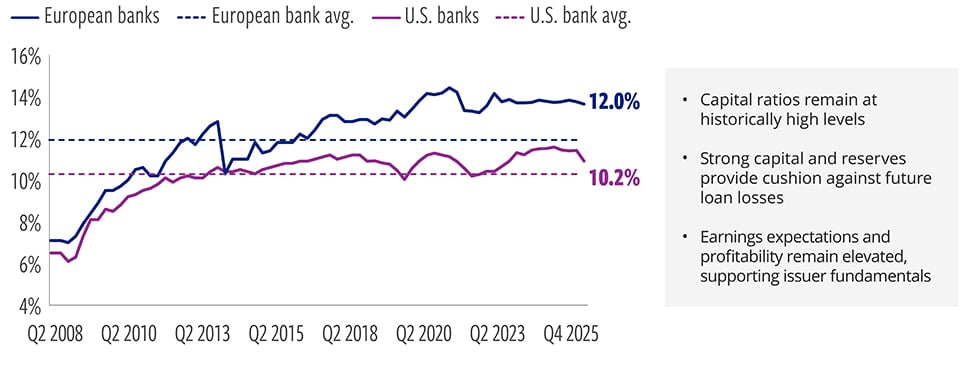
At March 31, 2026. Source: Bloomberg, Cohen & Steers.
Utilities, for instance, are benefiting from rising investment tied to artificial intelligence, data center growth and power infrastructure needs. These companies are generating healthy earnings and cash flows while operating under regulated business models that can provide stability across economic cycles.
These stronger fundamentals are showing up in credit ratings as well. Over the last several years, rating upgrades have substantially outpaced downgrades, reflecting healthier balance sheets, stronger capital levels and improved credit quality across the preferreds universe.
Upgrade momentum signals a higher-quality market
Annual credit rating upgrade-downgrade ratio
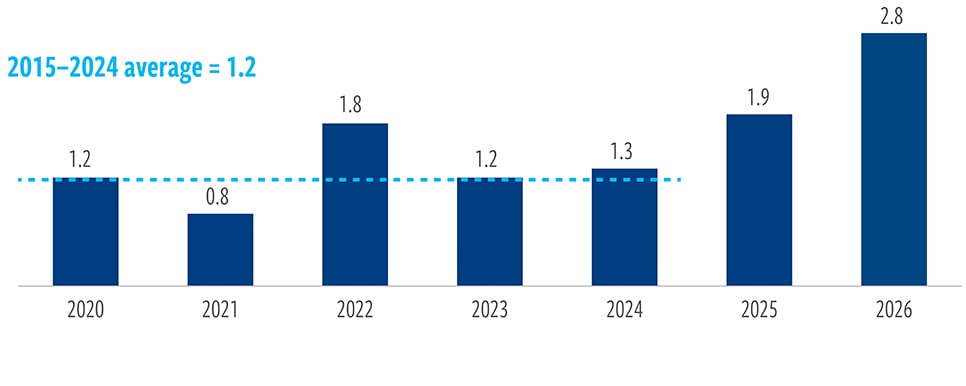
At June 30, 2026. Source: Bloomberg, Cohen & Steers. Past performance is no guarantee of future results.
What makes this especially compelling is the income investors receive.
Today, investment-grade preferreds offer yields around 7%. Achieving only modestly higher yields in high-yield bonds typically requires taking on substantially lower credit quality. The tight yield spread between the two points to attractive values for preferreds relative to history.
In our view, that’s the opportunity in preferred securities today.
Strong earnings support strong balance sheets. Strong balance sheets support credit quality. And that combination helps investors access some of the highest income available within investment-grade fixed income markets.
Data quoted represents past performance, which is no guarantee of future results. The information presented does not reflect the performance of any fund or account managed or serviced by Cohen & Steers, and there is no guarantee that investors will experience the type of performance reflected. There is no guarantee that any market forecast set forth in this video will be realized. There is no guarantee that any historical trend referenced herein will be repeated in the future, and there is no way to predict precisely when such a trend will begin. The mention of specific securities is not a recommendation or solicitation to buy, sell or hold any particular security and should not be relied upon as investment advice.
This video is for informational purposes and reflects prevailing conditions and our judgment as of 31 July 2026, which are subject to change. This material should not be relied upon as investment advice, does not constitute a recommendation to buy or sell a security or other investment and is not intended to predict or depict performance of any investment. This material is not being provided in a fiduciary capacity and is not intended to recommend any investment policy or investment strategy or take into account the specific objectives or circumstances of any investor. We consider the information in this video to be accurate, but we do not represent that it is complete or should be relied upon as the sole source of appropriateness for investment. Please consult with your investment, tax or legal professional regarding your individual circumstances prior to investing.
Risks of investing in preferred securities. An investment in a preferreds strategy is subject to investment risk, including the possible loss of the entire principal amount that you invest. The value of these securities, like other investments, may move up or down, sometimes rapidly and unpredictably. Our preferred strategies may invest in below-investment-grade securities and unrated securities judged to be below investment grade by the advisor. Below- investment-grade securities or equivalent unrated securities generally involve greater volatility of price and risk of loss of income and principal, and may be more susceptible to real or perceived adverse economic and competitive industry conditions than higher-grade securities.
Contingent capital securities (CoCos). CoCos are debt or hybrid securities with loss absorption characteristics built into the terms of the security, for example a mandatory conversion into common stock of the issuer under certain circumstances, such as the issuer’s capital ratio falling below a certain level. Since the common stock of the issuer may not pay a dividend, investors in these instruments could experience a reduced income rate, potentially to zero, and conversion would deepen the subordination of the investor, hence worsening the investor’s standing in a bankruptcy. Some CoCos provide for a reduction in the value or principal amount of the security under such circumstances. In addition, most CoCos are considered to be high yield securities and are therefore subject to the risks of investing in below-investment-grade securities.
Duration risk. Duration is a mathematical calculation of the average life of a fixed-income or hybrid security that serves as a measure of the security's price risk to changes in interest rates (or yields). Securities with longer durations tend to be more sensitive to interest rate (or yield) changes than securities with shorter durations. Duration differs from maturity in that it considers potential changes to interest rates, and a security's coupon payments, yield, price and par value and call features, in addition to the amount of time until the security matures. Various techniques may be used to shorten or lengthen a portfolio's duration. The duration of a security will be expected to change over time with changes in market factors and time to maturity.
Cohen & Steers Capital Management, Inc. (Cohen & Steers) is a U.S. registered investment advisory firm that provides investment management services to corporate retirement, public and union retirement plans, endowments, foundations and mutual funds. Cohen & Steers Asia Limited is authorized and regulated by the Securities and Futures Commission of Hong Kong (ALZ367). Cohen & Steers Japan Limited is a registered financial instruments operator (investment advisory and agency business and discretionary investment management business with the Financial Services Agency of Japan and the Kanto Local Finance Bureau No. 3157) and is a member of the Japan Investment Advisers Association. Cohen & Steers UK Limited is authorized and regulated by the Financial Conduct Authority (FRN458459). Cohen & Steers Ireland Limited is regulated by the Central Bank of Ireland (No.C188319). Cohen & Steers Singapore Private Limited is a private company limited by shares in the Republic of Singapore.
For recipients in the Middle East: This document is for informational purposes only. It does not constitute or form part of any marketing initiative or any offer to issue or sell (or any solicitation of any offer to subscribe or purchase) any products, strategies or other services, nor shall it or the fact of its distribution form the basis of, or be relied on in connection with, any contract resulting therefrom. In the event that the recipient of this document wishes to receive further information with regard to any products, strategies or other services, it shall specifically request the same in writing from us.