
The relationship between REITs and interest rates is often reduced to a simple but ultimately misguided rule of thumb: rates up, REITs down. History has been more nuanced.
Interest rates do not tell the whole story. REIT returns are not driven by rates alone. Fundamentals drive returns: cash flow growth, supply and demand dynamics, and valuations.
How sensitive are REITs to rates?
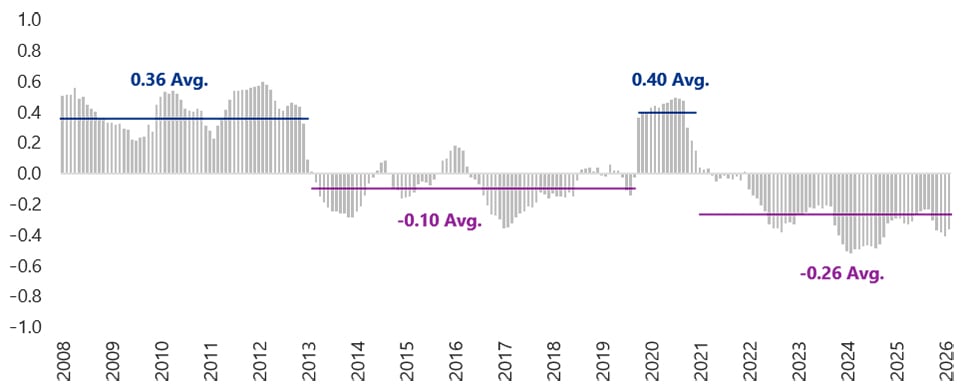
Correlations between REIT returns and changes in 10-year Treasury yields have repeatedly shifted over time. The level or direction of rates alone has not been a reliable predictor of REIT performance.
If rate changes were a predictor of REIT returns, a strong, persistent negative correlation would be observed.
Fundamentals matter more than rates
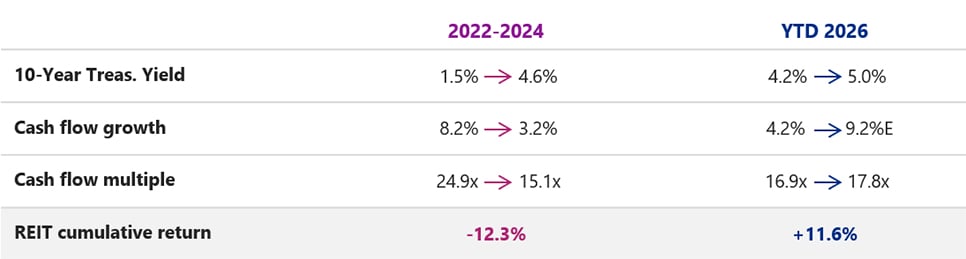
2022-2024 was about more than higher rates. REIT cash flow growth slowed as post-pandemic rent growth normalized, new supply emerged, and tighter financial conditions shut off external growth opportunities.
In 2026, many of those headwinds have faded. New supply has peaked, cash flow growth is accelerating, and valuations remain attractive versus equities.
Rates have not been a reliable predictor of REIT performance
(REITs vs. 10-year Treasury yields rolling 1-year correlations)(1)
We believe REITs are now in a long-term recovery cycle(2)
At September 21, 2026. Source: Bloomberg, Morningstar, Cohen & Steers.
Data quoted represents past performance, which is no guarantee of future results. The information presented above is for illustrative purposes only and does not reflect the performance of any fund or account managed or serviced by Cohen & Steers, and there is no guarantee that investors will experience the type of performance reflected above. There is no guarantee that any historical trend illustrated above will be repeated in the future, and there is no way to predict precisely when such a trend might begin. There is no guarantee that any market forecast set forth in this will be realized. An investor cannot invest directly in an index and index performance does not reflect the deduction of any fees, expenses or taxes.
(1) REITs represented by the FTSE Nareit All Equity REITs Index. The index is a market-capitalization-weighted index designed to measure the performance of publicly traded U.S. equity REITs
(2) Cash flow growth shows the weighted average funds available for distribution (FAD) growth by year. Cash flow multiple shows share price relative to funds available for distribution (FAD) per share. Cash flow data is from Cohen & Steers. Cohen & Steers data excludes FAD growth outliers of +/-100% and is based on the constituents of the FTSE Nareit All Equity REITs Index.
Risks of investing in real estate securities. The risks of investing in real estate securities are similar to those associated with direct investments in real estate, including falling property values due to increasing vacancies; declining rents resulting from economic, legal, political or technological developments; lack of liquidity; lack of availability of financing; limited diversification; sensitivity to certain economic factors, such as interest rate changes and market recessions; and changes in supply of or demand for similar properties in a given market. No representation or warranty is made as to the efficacy of any particular strategy or fund or the actual returns that may be achieved.
Cohen & Steers Capital Management, Inc. (Cohen & Steers) is a U.S. registered investment advisory firm that provides investment management services to corporate retirement, public and union retirement plans, endowments, foundations and mutual funds.
Correlation, based on daily data, measures how closely two statistics move together, ranging from -1.0 (perfect inverse relationship) to 1.0 (perfect positive relationship).