

In the wake of global supply shocks and strong demand, investors are turning to “old economy” companies across energy, metals and agriculture sectors for better growth opportunities and inflation resilience.
KEY TAKEAWAYS
- The commodity upcycle has arrived
With demand for physical resources reaching historic highs, prices for key commodities are setting records, highlighting the growth potential of natural resource companies. - Deglobalization is reshaping resource supply chains
Governments are securing high priority natural resources via on-shoring and friend-shoring with key allies, creating new opportunities for active managers. - The time for natural resource allocations is now
As new technologies transform our economy, real assets offer portfolio payoffs that are historically unsynchronized with broad equity markets.
Rising demand and tight supply of commodities drive a resurgence in resource equities
We have been arguing for some time that global markets are transitioning to an era of scarcity for commodities and the broad natural resource economy.
We believe this era has arrived, evidenced by last year’s price increases in key industrial metals like copper and aluminum, and oil price volatility sparked by the war in Iran, and restricted shipping through the Strait of Hormuz.
The impact on equity markets is hard to miss. While overall returns for the S&P 500 index were negative through the first quarter, “old economy” companies across energy, materials and industrial sectors were notably positive. This resurgence in real assets even has a catchy new phrase: HALO stocks (heavy assets, low obsolescence). The AI revolution is certainly here to stay, but it can’t happen without significant new supplies of critical metals and minerals still deep underground. Not to mention more power generation and cooling equipment.
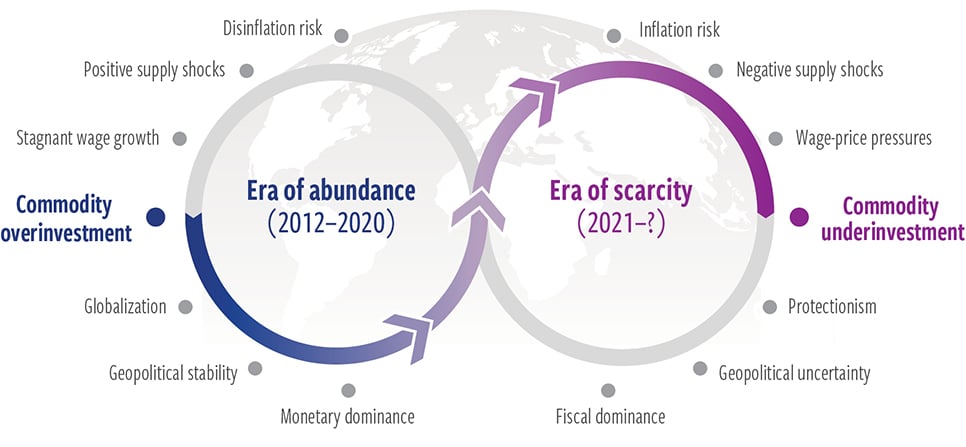
Today’s focus on the physical economy comes on the heels of an “era of abundance” (Exhibit 1). In a globalized economy—marked by just-in time deliveries of critical resources and geopolitical stability—there was widespread complacency about energy, metals and agriculture supplies. That system, however, hinged on friendly trading relationships and uninhibited delivery. With ample commodity supplies, many companies didn’t worry about shortages, prompting underinvestment in new production, highly concentrated supply chains, and a low base of inventories of critical materials.
EXHIBIT 1
Transitioning from a world of commodity abundance to an era of undersupply.
At March 31, 2026. Source: Cohen & Steers.
That world has noticeably changed. In today’s era of scarcity, energy and commodity shocks are on the rise, driven by resource protectionism (i.e., commodity export controls), geopolitical tensions and armed conflicts. Over the last five years, these jolts came in waves, starting with the global pandemic (2020), the war in Ukraine (2023), tariffs (2025) and now the war in the Middle East (2026).
All combined, these shocks revealed that our highly efficient supply chains were also quite precarious. The emphasis now is building more robust supply chains with redundancies in the system. This requires higher inventories of commodities to withstand shortages, and combinations of onshoring and friend-shoring with like-minded trading partners (deglobalization).
This pivot is already underway. It requires tapping new energy supplies, both at home and abroad, jumpstarting new mines for critical metals, and re-tooling the agriculture sector. In our view, accelerating this shift will require government actions, both in terms of capital infusions and much needed permitting reforms. These efforts are critical to expediting new production of critical natural resources worldwide.
Mounting demand requires dependable resource supplies
Today’s rising need for more energy, metals and agriculture has its roots in a growing stack of structural demand drivers, all turbocharged by a rapidly growing global middle class (Exhibit 2).
Beyond core economic growth, our demand vectors include “Energy Addition”—this includes alternative sources (from solar to wind and nuclear) and traditional energy supplies—AI technologies and data centers, and military defense buildouts. These overlapping demands require more natural resources than current projected supplies can meet, in what are already depleting sectors.
EXHIBIT 2
Four demand drivers for more natural resource supplies

For example, electricity demand from global data centers is forecast to triple by 2040, with total installed capacity reaching 550 gigawatts, more than five times 2022 levels. Meanwhile, estimates of future defense spending could reach $6 trillion by 2040 amid rising international tensions. Bear in mind, even higher spending is possible given the proposed $1.5 trillion U.S. military budget recently proposed for 2027.
Consider copper demand. New data centers and defense spending represent a combined increase of 3.5 million metric tons (MMt) of new annual copper demand by 2040.(1) In a market that’s already facing a 10 MMt copper supply gap from factors like expanding power grids and electric vehicles, this amplifies the shortfall even further. That’s why some analysts think copper may become the “new gold” in terms of price increases.
A key supply problem is that existing copper mines are getting older and less productive. Kick-starting new mines, however, requires major permitting reforms. (See sidebar)
Development hurdles stymie new copper mines
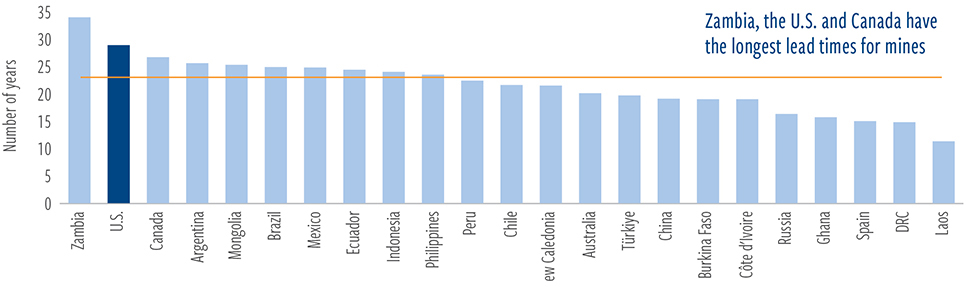
In 2024, S&P Global analyzed production timelines for 268 mines across the globe. Many had started the development application process but never entered production. Today, Resolution Copper, a potential new mine in the state of Arizona, has the capacity to meet a quarter of U.S. annual copper demand for the next 40 years. So, problem solved, right? Not exactly.
The U.S. has one of the longest lead times to develop mines, second only to Zambia. Case in point: the Resolution Copper deposits were first discovered in 1995, but the mine never got off the ground due to permitting hurdles. This year, a key court ruling may finally determine if this mine can move forward with development.
In our view, if governments are serious about securing more natural resources at home, it’s imperative that decades-long permitting stalemates receive appropriate scrutiny and action.
Average number of years to develop new mines by country
Includes 268 mines analyzed by S&P Global Market Intelligence
Data compiled February 21, 2004. DRC = Democratic Republic of Congo. Source: S&P Global Market Intelligence
In the near term, more expensive copper creates price frictions for energy grid and data center developers, impacting consumers with stickier inflation. By contrast, the war in Iran created price shocks that global consumers felt right away, either at the gas pump filling up cars, or from travel restrictions and work-from-home mandates across Asia.
Not all natural resources are created equal
With oil tankers restricted from the Strait of Hormuz, global oil prices jumped 40% to $100 a barrel, before fluctuating up and down from there.
Prices for distillates such as jet fuel, petrol and diesel quickly jumped in Singapore, which operates as Asia’s oil-trading hub, after China suspended its refined-product exports. Europe felt the squeeze too. After the war in Ukraine and Russian oil sanctions, Europe turned to the Gulf region and Asia for its diesel and jet fuel supplies.
So why have shares of oil producers moved up only a fraction of oil’s increase? The simplest explanation is that oil markets have been forecasting a quick resolution to the conflict.
As the cycle plays out, we expect fortunes among energy companies to diverge (i.e., shale oil fields vs. oil sands). Shale fields need constant investment during production, as they deplete more quickly than conventional oil fields. Depletion rates of +50% require significant annual capex to maintain volumes.
It’s a different story for Canada, in our view. As the world’s fourth largest oil producer, Canada has the third-largest proven oil reserves, mostly in the Alberta oil sands region.
Unlike shale oil that requires high ongoing investments, Canadian oil sands projects can take more than a decade to develop, but can then generate stable output for decades. This requires large upfront capital expenditures that go deep underground long before production even starts. In this way Canada’s oil sand producers operate more like mining companies than U.S. shale oil producers.
With 30–50 years of oil supplies ahead of them, a $10-per-barrel rise in oil prices can boost free cash flows by 50% for a Canadian oil sands operator versus a 30% lift for a U.S. shale producer. It takes active managers to unearth unique outcomes like these, across the natural resource landscape.
As the world’s fourth largest oil producer, Canada has the third-largest proven oil reserves, mostly in the Alberta oil sands region.
Safeguarding critical metal supplies at home and abroad
Last year’s historic rally for metals saw some of the largest price increases in over a decade. Silver, cobalt and gold, among others, climbed 148%, 118% and 65%, respectively (Exhibit 3). This price rally underscores our era of scarcity thesis, where accelerating structural demands are running headfirst into shortages that will take years to reverse.
Consider recent armed conflicts and rising demand for military drones, first accelerated by the war in Ukraine and continuing now in the Middle East. Drones are a rapidly growing military technology that’s reshaping how conflicts are waged.
These drones often contain carbon fiber, rare-earth magnets, lithium-ion cells, and gallium-nitride chips; all comprised of key metals and minerals that originate from refineries and processors, often in China.
As these conflicts illustrate, disruptions to metal supplies can be a national security threat, not to mention economically damaging. Restricting access to metals with export controls re-emphasizes the need for friend-shoring and bringing resource production back home. (See case study)
EXHIBIT 3
Rip-roaring metals price increases in 2025
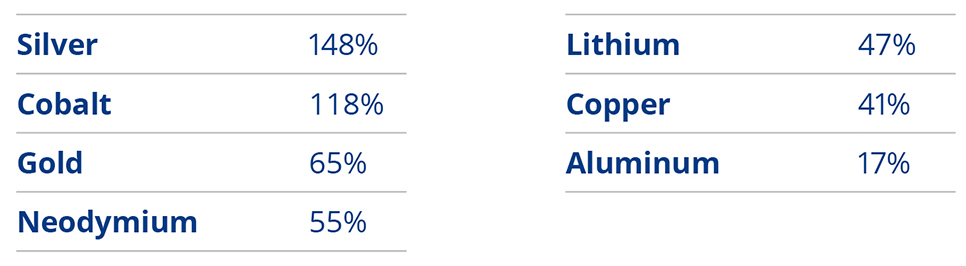
Dates December 31, 2024 to December 31, 2025. Source: Bloomberg. Silver United States Dollar Spot, LME Cobalt Spot, Gold United States Dollar Spot, China Neodymium Metal 99% FOB, S&P GSCI Lithium (USD), Generic 1st Copper (CMX), LME Primary Aluminum Cash.
A case study: Japan’s dependence on China
In 2010, China used export restrictions of rare earth minerals to punish Japan over a series of maritime disputes involving fishing boats. At that time, Japan depended on China for around 90% of its industrial rare earths.
After China cut off its rare earth exports, Japan’s production lines nearly ground to a halt. A decade later, Japan was able to reduce its dependence on China’s rare earths to 60%, although that has crept back up to 70% more recently. As for the remaining rare earths, Japan’s imports from Malaysia are estimated to cost 50% more on average compared to China supplies.
As this example illustrates, building new metal supply chains is sometimes too big for individual companies to go it alone. Governments may need to step in with capital to secure production closer to home.

Trade frictions tighten metals supply
Efforts to de-globalize metal supplies are now accelerating. Friend-shoring among countries with similar economic values, such as the U.S., Japan and Australia, is taking hold. To pull this off, some governments are jumpstarting new mines with capital infusions and equity-like stakes.
That said, bringing supplies closer to home can be a long and expensive endeavor. Consider the critical mineral antimony. It’s a key input for the defense industry, including armor-piercing ammunition, missiles, night vision goggles, infrared sensors and precision optics.
EXHIBIT 4
Global antimony mine production 2025

At February, 2026. Source: U.S. Geological Survey (USGS) 2025 estimates.
In 2025, China mined 36 percent of the world’s antinomy, while processing nearly 74 percent of global supplies (Exhibit 4). At this scale, China can withhold access to antimony, giving it geopolitical leverage by releasing or withholding flows. Indeed, China barred antimony exports to the U.S. in December 2024, before suspending the ban in November 2025 for a year as a trade truce, triggering a rollercoaster in antimony prices (Exhibit 5).
In the U.S., antimony supplies—which are often found in gold mines—used to come from the Stibnite Gold Mine in Idaho, before ceasing operations in the 1990s. Perpetua Resources plans to reopen the mine by 2029, having completed an eight-year permitting process, and receiving $24.8 million from the U.S. Department of Defense, and a $2.7 billion loan from the U.S. Export Import Bank to help finance the project.
To process antimony, Perpetua Resources is partnering with a U.S. federal research lab on a pilot processing plant, capable of refining antimony ore to military-grade specifications. For mining shareholders who’ve been adamant that CEOs embrace more capital discipline, government investments are welcome, just as long as future company profits also flow back to everyday investors.
U.S. President Donald Trump’s tariff regime, which aims to deglobalize and re-shore supplies, is shaped by a strategic focus on securing critical metals and minerals. The strategy includes rebuilding both domestic and allied production capacity abroad for natural resources that are essential to energy, defense and advanced manufacturing.
EXHIBIT 5
China export ban sends antimony prices on rollercoaster ride
Monthly antimony price January 2020 – April 2026
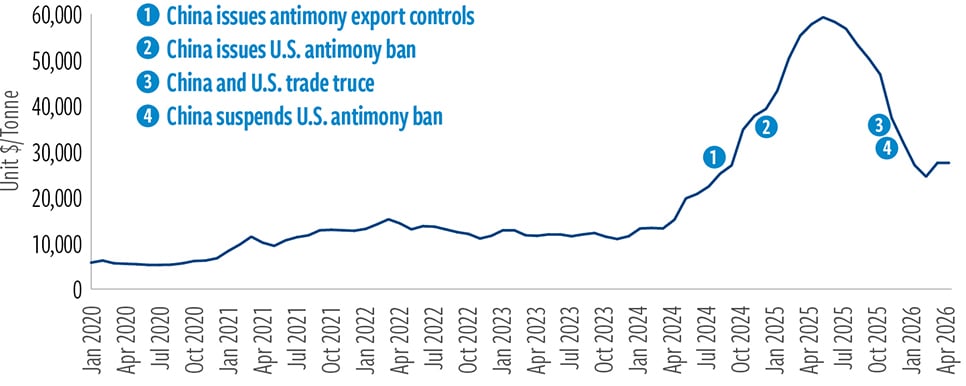
Dates January 2020 to March 2026. Antimony, Rotterdam. Source: Bloomberg.
Add balance to market swings with natural resources
The newest Wall Street acronym HALO points to a clear shift in market sentiment. There’s a palpable uncertainty about new AI tools, and the impact they will have not just on software stocks, but the broader economy, including jobs. Meanwhile, the capital intensity of U.S. hyperscalers is rapidly rising, and could reach $3 trillion by 2030. To compensate for today’s AI uncertainty, more investors are turning to sectors tied to the real assets and physical production that a growing global middle class and hyperscalers alike need (Exhibit 6). After all, you can’t replace an electricity grid with an AI bot.
Indeed, the AI revolution itself is incredibly energy and metals intensive. Today’s hyperscalers and natural resource companies are, after all, intricately intertwined. For example, Amazon Web Services (AWS) recently signed a two year copper agreement with the mining giant Rio Tinto. This arrangement helps Amazon secure new copper supplies inside the U.S. to feed its rapidly expanding AI data centers.
EXHIBIT 6
AI rattles software companies as investors favor energy and utilities
S&P 500 sub-indices rebased, YTD
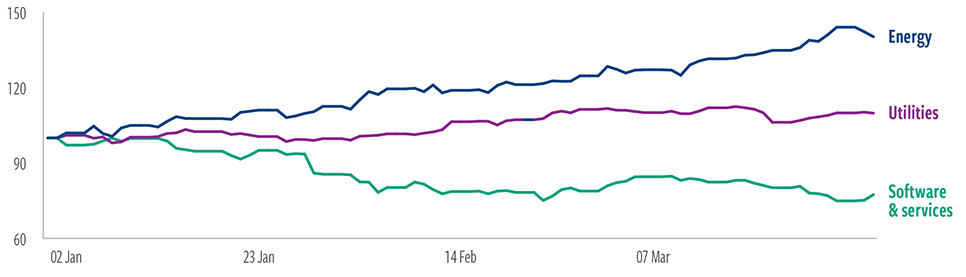
At March 31, 2026. Source: Morningstar. S&P 500 Energy (Industry Group) Index, S&P 500 Software (Industry) Index, S&P 500 Utilities (Sector) Index.
Of course, Wall Street is aware of this shift in sentiment, which we believe is grounded in a macroeconomic environment that we call the era of scarcity. As we’ve discussed, this new era started with the shock of the global pandemic and the rise of interest rates to tackle inflation.
We believe the shift is here to stay, as investment cycles become longer and deeper. Indeed, despite the strong performance of natural resource equities in 2025, these companies still trade at attractive absolute and relative valuations, offering further upside potential in our view (Exhibit 7). Allocations to natural resource equities give investors a way to benefit from the AI revolution, but at far more attractive valuations compared to broad equities.
Adding a dedicated allocation to natural resource equities has historically improved a broad equity market portfolio. Most notably, similar to other real assets like infrastructure and real estate, returns for natural resource equities have shown attractive levels of sensitivity to inflation, particularly when it surprises to the upside.
EXHIBIT 7
Natural resources are trading near their cheapest levels in history versus global equites
Price-to-Cash Flow Spread: global natural resources versus global equities

As of March 31, 2026. Source DataStream and Cohen & Steers
Note: Valuation spread measured by taking the relative z-score of price-to-cash flow of global equities versus global natural resources.
With payoffs that are typically unsynchronized with the broader equity market, a strategic allocation to resource equities can improve overall portfolio returns, without adding to volatility and maintaining a portfolio’s Sharpe ratio. In short, investors are rewarded with greater diversification and meaningfully positive sensitivity to inflation (Exhibit 8).
With more investors asking about HALO, advisors can model how a client’s portfolio could have improved historically with natural resource equities, or a broader set of real assets that incorporate infrastructure, commodity futures and real estate.
Bottom line, resource equities offer needed diversification, plus the ability to participate in key megatrends like the AI revolution and the energy boom across traditional and alternative sources. With equity volatility on the rise, harnessing these long-term demand drivers inside portfolios can help clients feel more confident about the future and their portfolios.
EXHIBIT 8
Natural resources offer superior protection from rising inflation versus stocks and bonds
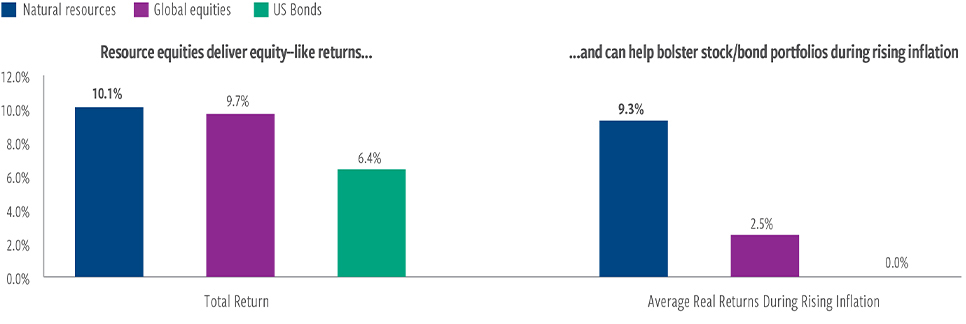
As of March 31, 2026. Data since 1973 due to data availability. Source: Barclays, Bloomberg, Dow Jones, FTSE, S&P, Refinitiv Datastream and Cohen & Steers.
Data quoted represents past performance, which is no guarantee of future results.
ABOUT THE AUTHORS

Tyler Rosenlicht, Senior Vice President, is a portfolio manager for Global Listed Infrastructure and serves as Head of Natural Resource Equities.
Index Definitions and important disclosures
An investor cannot invest directly in an index, and index performance does not reflect the deduction of any fees, expenses or taxes. Index comparisons have limitations, as volatility and other characteristics may differ from a particular investment.
Natural resource equities: 50/50 Blend of Datastream World Oil & Gas and Datastream World Basic Materials through 05/31/08; S&P Global Natural Resources Index thereafter. The Datastream World Index Series encompasses global indexes of companies in their respective sectors (Datastream World Oil & Gas and Datastream World Basic Materials) and is compiled by LSEG Datastream. The S&P Global Natural Resources Index includes 90 of the largest publicly traded companies in natural resources and commodities businesses that meet specific investability requirements, offering investors a diversified, liquid and investable equity exposure across three primary commodity-related sectors: Agribusiness, Energy and Metals & Mining. The S&P North American Natural Resources Index represents U.S.-traded securities that are classified under the GICS® energy and materials sector, excluding the chemicals industry, and the steel sub-industry. Global equities: MSCI World Index, a market-capitalization-weighted index consisting of a wide selection of stocks traded in 24 developed markets. U.S. bonds: The Bloomberg U.S. Aggregate Bond Index is a broad-based index that measures the investment grade USD-denominated fixed-rate taxable bond market.
Past performance is no guarantee of future results. There is no guarantee that any historical trend illustrated/referenced above will be repeated in the future, and there is no way to predict precisely when such a trend might begin. There is no guarantee that any market forecast set forth in this commentary will be realized. The views and opinions in the preceding commentary are as of the date of publication and are subject to change. Diversification does not ensure a profit or guarantee to protect against loss. There is no guarantee that actively managed investments will outperform the broader market.
This material represents an assessment of the market environment at a specific point in time and should not be relied upon as investment advice, does not constitute a recommendation to buy or sell a security or other investment, and is not intended to predict or depict performance of any investment. This material is not being provided in a fiduciary capacity and is not intended to recommend any investment policy or investment strategy or take into account the specific objectives or circumstances of any investor. We consider the information in this presentation to be accurate, but we do not represent that it is complete or should be relied upon as the sole source of appropriateness for investment. Please consult with your investment, tax or legal professional regarding your individual circumstances prior to investing. The views and opinions expressed are not necessarily those of any broker/dealer or its affiliates. Nothing discussed or suggested should be construed as permission to supersede or circumvent any broker/dealer policies, procedures, rules or guidelines.
Natural resource equities risks. The market value of securities of natural resource companies may be affected by numerous factors, including events occurring in nature, inflationary pressures and international politics. Because the strategy invests significantly in natural resource companies, there is the risk that the strategy will perform poorly during a downturn in the natural resource sector.
Cohen & Steers Capital Management, Inc. (Cohen & Steers) is a U.S. registered investment advisory firm that provides investment management services to corporate retirement, public and union retirement plans, endowments, foundations and mutual funds. Cohen & Steers Asia Limited is authorized and regulated by the Securities and Futures Commission of Hong Kong (ALZ367). Cohen & Steers Japan Limited is a registered financial instruments operator (investment advisory and agency business and discretionary investment management business with the Financial Services Agency of Japan and the Kanto Local Finance Bureau No. 3157) and is a member of the Japan Investment Advisers Association.
Cohen & Steers UK Limited is authorized and regulated by the Financial Conduct Authority (FRN458459). Cohen & Steers Ireland Limited is regulated by the Central Bank of Ireland (No.C188319). Cohen & Steers Singapore Private Limited is a private company limited by shares in the Republic of Singapore.
For recipients in the Middle East: This document is for informational purposes only. It does not constitute or form part of any marketing initiative or any offer to issue or sell (or any solicitation of any offer to subscribe or purchase) any products, strategies or other services, nor shall it or the fact of its distribution form the basis of, or be relied on in connection with, any contract resulting therefrom. In the event that the recipient of this document wishes to receive further information with regard to any products, strategies or other services, it shall specifically request the same in writing from us.
All investing involves risk. Loss of principal is possible.
Investors should consider the investment objectives, risks, charges and expenses carefully before investing. For a prospectus or summary prospectus with this and other information about the Fund, please call (888) 737-6370 or visit our website at www.cohenandsteers.com. Read the prospectus or summary prospectus carefully before investing.
Foreside Fund Services, LLC, distributor.