
Rapidly shifting narratives and geopolitical disruption highlight hybrid credit’s role as a high-quality, stable source of income
The first quarter reminded investors just how quickly market narratives can change. Early in the year, economic conditions were generally supportive of credit. Growth was holding up, inflation was still elevated but trending toward central banks’ targets, and risk assets were performing well.
That changed in late February with the onset of the U.S.–Iran conflict. Disruptions to global energy production and transportation raised concerns about an energy driven inflation shock that could keep monetary policy tighter for longer, even as growth expectations softened.
Markets turned volatile, and both equities and fixed income pulled back, erasing earlier gains. Within hybrid credit, longer duration, exchange listed securities were most affected by the rate driven sell off.
In environments like this, where rate expectations are shifting and volatility is elevated, income becomes an increasingly important driver of fixed income returns. When forward visibility is limited, returns are less about timing rate moves and more about the durability and level of income you’re earning along the way.
Hybrid credit securities continue to offer attractive income, backed by high quality issuers, which can help cushion portfolios during periods of market stress and policy uncertainty. Investors would have to take on significantly more risk to achieve higher yields in today’s market.
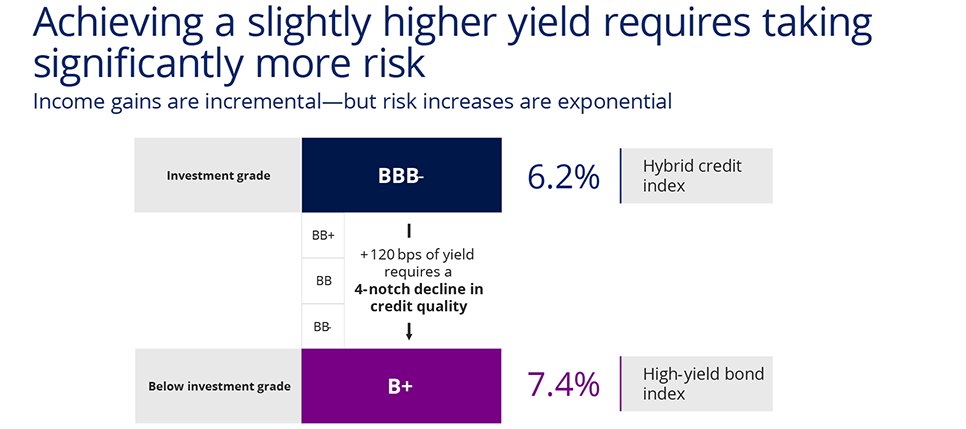
At March 31, 2026. Source: ICE BofA.
Yields shown on a yield-to-worst basis. Credit ratings represented by the weighted-average ICE Composite credit rating of total indexes. Sub-index values derived from ICE BofA High-Yield Master main index, which tracks the performance of U.S. dollar-denominated below-investment-grade corporate debt publicly issued in the U.S. domestic market. As of 3/31/2026, the High-Yield Bond Sub-Index (BB)represents 59% of the main index; High-Yield Bond Sub-Index (B) represents 32% of the main index, and High-Yield Bond Sub-Index (CCC) represents 9% of the main index. Below investment grade is represented by the B+ sub-component of the High-Yield Bond Sub-Index in the ICE BofA High-Yield Master Index.
We also saw modest widening in credit spreads during the quarter, as higher inflation and weaker growth prospects unsettled markets. However, the move was contained—reflecting strong underlying credit fundamentals and expectations that the conflict would remain limited.
Importantly, hybrid credit has relatively little exposure to the areas of credit where stress is building, particularly parts of private credit. Banks and insurance companies—the primary issuers of hybrid credit—entered this period with strong balance sheets, robust capital, and regulatory frameworks that have pushed higher risk lending outside the banking system. That insulation has helped hybrid credit weather credit volatility better than many investors might expect.
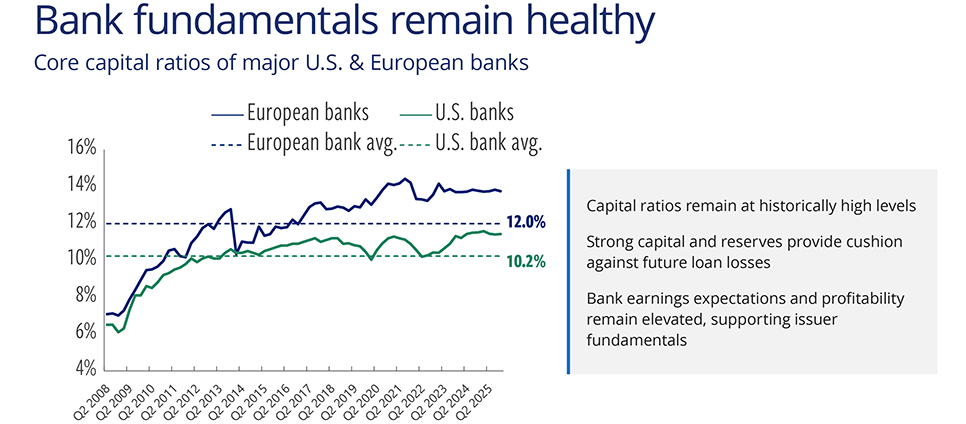
At December 31, 2025. Source: Bloomberg, Cohen & Steers.
Core capital ratio is the ratio of core (common equity) capital to total risk-weighted assets. Banks must meet a minimum core capital requirement as dictated by local banking laws and regulations. Higher core capital ratios have helped to strengthen banks’ balance sheets and to improve their credit quality. Core Capital ratios are based on the largest U.S. and European banks, respectively.
A third theme shaping the hybrid credit market, we have seen increased issuance by non-financials, such as utilities and pipelines, adding diversification to the hybrid credit market. This issuance is often directly tied to rising capital needs driven by AI adoption, data center expansion, and the growing importance of reliable energy infrastructure. While AI increases investment demands and near term costs, the sectors benefit from scale, regulation, and embedded infrastructure that helps protect earnings durability and mitigate disruption risk.
At the same time, the hybrid credit market remains diverse and liquid, allowing investors to manage duration, adapt positioning, and maintain flexibility during periods of market dislocation—particularly as lower coupon and longer duration securities reprice in a higher rate environment.
In a quarter marked by geopolitical shocks and shifting policy expectations, hybrid credit securities continue to offer a compelling mix of income, resilience, and flexibility—making them an important component of income focused portfolios today.
Data quoted represents past performance, which is no guarantee of future results. The information presented does not reflect the performance of any fund or account managed or serviced by Cohen & Steers, and there is no guarantee that investors will experience the type of performance reflected. There is no guarantee that any market forecast set forth in this video will be realized. There is no guarantee that any historical trend referenced herein will be repeated in the future, and there is no way to predict precisely when such a trend will begin. The mention of specific securities is not a recommendation or solicitation to buy, sell or hold any particular security and should not be relied upon as investment advice.
This video is for informational purposes and reflects prevailing conditions and our judgment as of 16 April 2026, which is subject to change. This material should not be relied upon as investment advice, does not constitute a recommendation to buy or sell a security or other investment and is not intended to predict or depict performance of any investment. This material is not being provided in a fiduciary capacity and is not intended to recommend any investment policy or investment strategy or take into account the specific objectives or circumstances of any investor. We consider the information in this video to be accurate, but we do not represent that it is complete or should be relied upon as the sole source of appropriateness for investment. Please consult with your investment, tax or legal professional regarding your individual circumstances prior to investing.
Risks of Investing in Preferred and Hybrid Credit Securities. An investment in a preferred strategy is subject to investment risk, including the possible loss of the entire principal amount that you invest. The value of these securities, like other investments, may move up or down, sometimes rapidly and unpredictably. Our preferred strategies may invest in below-investment-grade securities and unrated securities judged to be below investment grade by the advisor. Below-investment-grade securities or equivalent unrated securities generally involve greater volatility of price and risk of loss of income and principal, and may be more susceptible to real or perceived adverse economic and competitive industry conditions than higher-grade securities.
Contingent capital securities (CoCos). CoCos are debt or preferred securities with loss absorption characteristics built into the terms of the security, for example a mandatory conversion into common stock of the issuer under certain circumstances, such as the issuer’s capital ratio falling below a certain level. Since the common stock of the issuer may not pay a dividend, investors in these instruments could experience a reduced income rate, potentially to zero, and conversion would deepen the subordination of the investor, hence worsening the investor’s standing in a bankruptcy. Some CoCos provide for a reduction in the value or principal amount of the security under such circumstances. In addition, most CoCos are considered to be high yield securities and are therefore subject to the risks of investing in below-investment-grade securities.
Duration risk. Duration is a mathematical calculation of the average life of a fixed-income or preferred security that serves as a measure of the security's price risk to changes in interest rates (or yields). Securities with longer durations tend to be more sensitive to interest rate (or yield) changes than securities with shorter durations. Duration differs from maturity in that it considers potential changes to interest rates, and a security's coupon payments, yield, price and par value and call features, in addition to the amount of time until the security matures. Various techniques may be used to shorten or lengthen a portfolio's duration. The duration of a security will be expected to change over time with changes in market factors and time to maturity.
Cohen & Steers Capital Management, Inc. (Cohen & Steers) is a U.S. registered investment advisory firm that provides investment management services to corporate retirement, public and union retirement plans, endowments, foundations and mutual funds. Cohen & Steers Asia Limited is authorized and regulated by the Securities and Futures Commission of Hong Kong (ALZ367). Cohen & Steers Japan Limited is a registered financial instruments operator (investment advisory and agency business and discretionary investment management business with the Financial Services Agency of Japan and the Kanto Local Finance Bureau No. 3157) and is a member of the Japan Investment Advisers Association. Cohen & Steers UK Limited is authorized and regulated by the Financial Conduct Authority (FRN458459). Cohen & Steers Ireland Limited is regulated by the Central Bank of Ireland (No.C188319). Cohen & Steers Singapore Private Limited is a private company limited by shares in the Republic of Singapore.
For recipients in the Middle East: This document is for informational purposes only. It does not constitute or form part of any marketing initiative or any offer to issue or sell (or any solicitation of any offer to subscribe or purchase) any products, strategies or other services, nor shall it or the fact of its distribution form the basis of, or be relied on in connection with, any contract resulting therefrom. In the event that the recipient of this document wishes to receive further information with regard to any products, strategies or other services, it shall specifically request the same in writing from us.