

A strategic allocation to real assets—spanning real estate, infrastructure,
commodities and natural resource equities—can help strengthen retirement
portfolios across three dimensions.
KEY TAKEAWAYS
- Harnessing positive inflation sensitivity
Many real asset cash flows are tied to inflation, historically delivering strong results when inflation rises or surprises to the upside. - Diversifying target date funds for inflation
Inflationary periods mean rethinking equity and bond proportions by integrating real assets as powerful inflation shock absorbers. - Boosting future purchasing power
A diversified real assets allocation can help protect the purchasing power of retirement savings by mitigating the impact of inflation.
Inflation is top-of-mind for retirement savers
A much more difficult return environment than investors have experienced in recent decades could be a particular challenge for retirement investors.
Compared to the last 10 years, we forecast slower real economic growth, stubbornly high inflation and greater volatility over the next decade.
The result will likely be lower profit margins and lower returns for the broad equity market. Bonds are likely to be more volatile as this happens, making them less effective in counteracting the volatility of stocks.
At the same time, higher and more volatile inflation could likely erode the purchasing power of savings, making it harder for retirement portfolios to support future living expenses.
Those factors would be a headwind for retirement savers, many of whom rely on traditional target-date funds and count on stocks for long-term growth and bonds for stability and income.
In contrast, we believe real assets are well positioned in this market environment, adding inflation sensitivity, diversification from stocks and bonds, and potentially strong performance in a market environment characterized by persistent inflation risk, supply shocks, commodity underinvestment, protectionism and geopolitical uncertainty.
Benefits of a real assets blend
A diversified blend of real assets—including real estate securities, listed infrastructure, commodities and natural resource equities— may help enhance a portfolio in three key ways:
- Positive inflation sensitivity to help mitigate the potentially damaging effects of accelerating inflation.
- Diversification potential from distinct performance drivers that typically result in low correlations, both among real assets categories and vs. stocks and bonds.
- Attractive return potential over full market cycles, with a history of attractive risk-adjusted performance.
Let’s focus on inflation.
For much of the post financial crisis era, inflation was a secondary concern for retirement investors. Consumer prices were stable, interest rates were low, and stock and bond portfolios delivered strong real returns.
That world has changed. Inflation has not only returned at higher levels, but with greater volatility.
A portfolio that mitigates the impact of inflation can protect the future purchasing power of retirement nest eggs. That’s where we believe real assets come into play.
The economic drivers of real assets are often directly or indirectly tied to inflationary trends, historically resulting in outsized returns when inflation exceeds expectations. For example, the release of pent-up consumer demand, which is one of the drivers of inflation today, stands to benefit assets that struggled the most early in the pandemic such as commodities, natural resource equities, real estate and infrastructure.
An allocation to a blend of real assets may help preserve future purchasing power, potentially offsetting the weak or even negative inflation sensitivity of traditional portfolios concentrated in stocks and bonds.
A new inflation regime
Starting with the global pandemic and continuing in more recent years, inflation has consistently surprised to the upside, confounding expectations of a quick return to the “old normal” of low and stable prices. Although headline inflation has moderated from higher peaks, underlying inflation pressures remain a thorny hurdle for classic 60/40 portfolios of stocks and bonds.
Higher energy prices from recent geopolitical events or higher grocery prices are poignant reminders of inflationary pressures. Cohen & Steers forecasts consumer inflation to average 3.0% annually in the U.S. over the next 10 years, below post-pandemic peaks but well above the 1.6% experienced in the last cycle and significantly higher than the Federal Reserve’s long-term 2.0% target.
Real assets are often directly or indirectly tied to inflationary trends, historically resulting in outsized returns when inflation exceeds expectations.
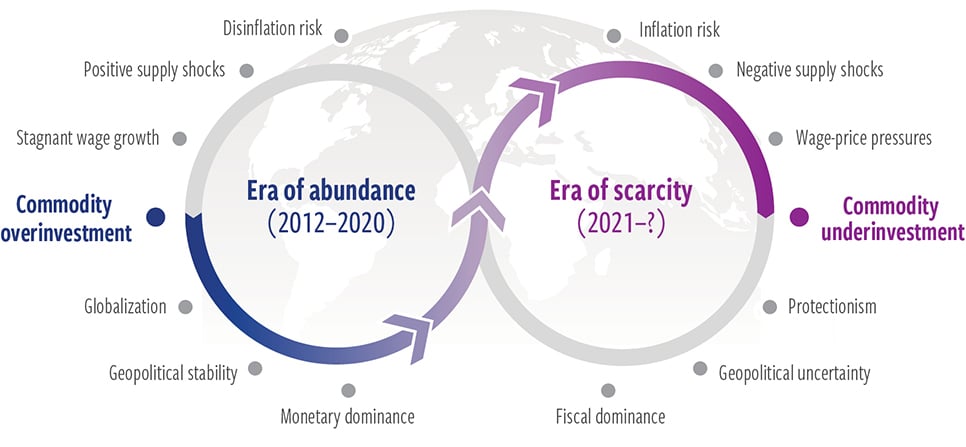
The key factor is that the world has fundamentally shifted from a period we reference as an era of abundance to an era of scarcity (Exhibit 1).
Quantitative easing, globalization, stagnant wage growth, and geopolitical stability were the hallmarks of the era abundance that led to low inflation. Today, labor markets remain tight with sustained wage-price pressures. Meanwhile, ongoing energy and commodity supply shocks continue to amplify inflation, driven by resource protectionism (i.e., export controls), geopolitical tensions and armed conflicts.
Over the last five years, a series of supply shocks came in waves, starting with the pandemic (2021), the war in Ukraine (2023), tariffs (2025) and the war in the Middle East (2026).
Throughout these shocks, sell-side economists kept forecasting inflation would soon bend toward 2%, only to be wrong year after year. All combined, actual inflation exceeded market implied inflation breakevens by 2.05% each year.(1)
Inflation surprises are, by definition, unforecastable. And it is the tendency of real assets to respond structurally to inflation shocks that makes them so valuable in the context of broader asset allocations.
EXHIBIT 1
Transitioning from a world of commodity abundance to an era of undersupply.
At March 31, 2026. Source: Cohen & Steers.
Inflation retirement risks and real assets
For investors saving for retirement, inflation shocks present a direct threat to their future financial security. That’s because inflation erodes the purchasing power of savings, increasing the odds that a retirement nest egg won’t last through retirement. Elevated inflation means higher costs for essential goods, such as food, clothing, shelter and gasoline.
With traditional target date funds, investors rely on stocks for long-term growth and bonds for stability and income. This framework assumes bonds will offset equity risk by preserving capital during periods of market stress.
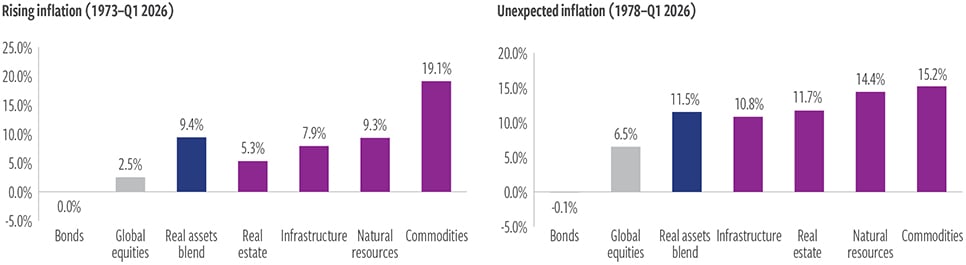
Inflationary environments, however, can undermine both sides of this stock-and-bond equation. Historically, stocks and bonds underperform during periods of rising inflation, and when inflation spikes unexpectedly (Exhibit 2).
By contrast, it’s against this inflation backdrop that real assets often shine brightest in terms of returns.
EXHIBIT 2
Real assets have historically benefited from both rising and unexpected inflation
Annual average real return
At March 31, 2026. Source: Barclays, Bloomberg, Dow Jones, FTSE, S&P, Refinitiv Datastream and Cohen & Steers.
The mention of specific commodities is not a recommendation or solicitation to buy, sell or hold any commodity interests. Please refer to the Index associations and definitions page for index definitions. Inflation is measured using the Consumer Price Index (CPI) for all urban consumers, published by the United States Department of Labor’s Bureau of Labor Statistics. Rising inflation is measured as a positive year-over-year increase in the 12-month inflation rate. Unexpected inflation is measured as a positive difference between the year-over-year realized inflation rate and lagged 1-year ahead expected inflation. Expected inflation as measured reflects median inflation expectation from University of Michigan Survey of 1-Year Ahead Inflation Expectations. A real rate of return is the annual percentage return realized on an investment, which is adjusted for changes in prices due to inflation.
How real assets harness inflation
The economic drivers of real assets are tied to inflationary trends, both directly and indirectly, often resulting in rising commodity prices, and higher revenues and cash flows when inflation exceeds expectations.
Take tradable commodity futures. Among the four real asset categories that constitute our Real Assets Blend, commodities tend to generate the highest returns when inflation surprises to the upside. They do so by capturing scarcity premiums arising from supple/demand imbalances across energy, metals and agriculture.
Natural resource companies that produce food, energy and metals also benefit from inflationary pressures. Because demand for essential resources typically remains strong (inelastic) despite inflation, producers can pass along higher costs of labor and other inputs onto customers.
Rising prices of key materials (such as wheat, oil and copper) can therefore increase cash flows and widen profit margins among natural resource producers.
In real estate, contracted revenues tied to inflation play a key role. Commercial leases for industrial warehouses and healthcare facilities, for example, link rents to inflation via contractual escalators that automatically rise with inflation, supporting profits. Landlords of properties with shorter leases, such as self-storage and apartments, raise rents in line with higher inflation when leases renew.
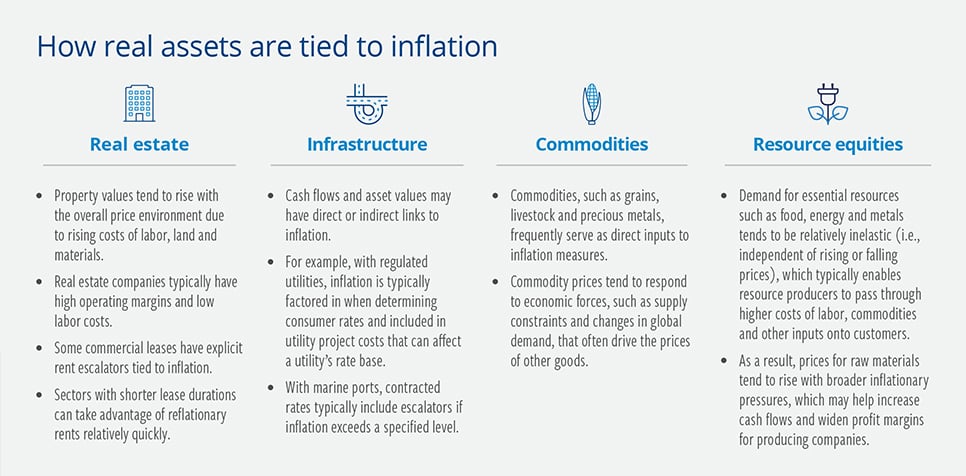
This same dynamic applies to infrastructure. Communications and data infrastructure companies, for example, typically have long-term contracts that include inflation escalators that increase revenues if inflation spikes. Within the utilities sector, regulators stipulate the rates that companies can charge, typically allowing them to pass along rising operating costs from inflation onto consumers.
Showing clients the historical outperformance of real assets during inflationary environments is one way to convey the benefits.
Rethinking retirement portfolios for a new regime
Today’s inflationary pressures don’t mean abandoning traditional asset classes. Equities and bonds remain foundational components of long- term portfolios. That said, inflation risk does mean rethinking allocation proportions, particularly if they were built for a low inflation world of abundance and stable geopolitics.
This is especially so for investors who are approaching retirement in a decade or actively making nest egg withdrawals.
For these investors, inflation is not about predicting the next inflation print. It’s about building portfolios that use real assets as a powerful inflation shock absorber.
After a spate of high inflation, some advisors recommend retirees cut back on spending, especially if it’s early in retirement. However, as people are living longer and paying more for late-in-life medical care, it is imperative that nest eggs have more inflation resilience. A strategic allocation to real assets offers further diversification beyond stocks and bonds, plus increasingly important inflation resilience.
Real assets categories have been outshining equity indexes, earning the acronym HALO: heavy assets, low obsolescence.
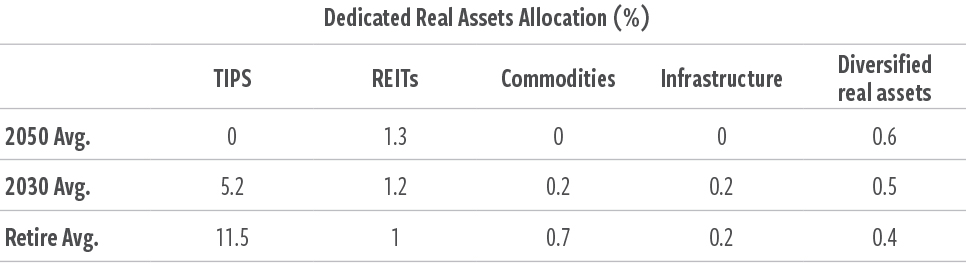
As for today’s target-date funds, they’ve grown to be the most popular option in participant-directed group retirement plans. That said, their inflation resilience is often restricted, with sparse allocations to TIPS and listed REITs, and minimal commodity exposures (Exhibit 3).
We believe that target-date funds are one of the most important tools available to average participants in a group plan. However, it is important to consider each allocation in a retirement plan and determine if these allocations provide uncorrelated performance when it’s needed most.
As fixed income securities linked to inflation, TIPS provide investors with a “fixed” real return. Over the lifetime of the bond, they are designed to outperform Treasuries when inflation is higher than expected, and vice versa.
However, when real interest rates rise substantially the mark-to-market return may result in losses for TIPS. During periods of higher inflation and higher rates, such as 2022, both stocks and bonds can suffer—with higher rates dragging down fixed income returns, while rising costs can impact equity valuations.
EXHIBIT 3
Target date funds provide limited allocations to inflation-sensitive assets
Dedicated Real Assets Allocation (%)
As of March 31, 2026. Source: Morningstar, Cohen & Steers.
Today, inflation remains a key concern for investors making withdrawals from retirement nest eggs, or who expect to. That’s because inflation creates a permanent increase in the baseline costs of essential living expenses. Although the rate of inflation may slow, price declines (known as deflation) are rare.
If an inflation spike arrives early in retirement, for example, the higher annual withdrawals needed to match new baseline costs will cascade across all the years to follow, depleting the nest egg faster. Integrating real assets can help extend the retirement portfolio’s longevity by reducing the negative inflation beta of a traditional 60/40 nest egg.
Positive inflation sensitivity isn’t the only feature sparking interest in real assets. Growing supply/demand imbalances in the physical world means real assets categories have been outshining equity indexes with concentrated exposures to hyperscalers and chip makers. This performance helped real assets earn the acronym HALO: heavy assets, low obsolescence.
Given today’s evolving tariff policies and geopolitical fragmentation, more retirement-focused investors are making strategic allocations to real assets to support long-term growth potential, while also enhancing portfolio diversification and positive inflation resilience.
Integrating real assets can help extend a retirement portfolio’s longevity by reducing the negative inflation beta of a traditional 60/40 nest egg.
(1) Over the past five years, Headline CPI of 4.44% through February 2026 exceeded prior market implied breakevens of 2.39% by 2.05% per year.
ABOUT THE AUTHORS

Vince Childers, CFA, Senior Vice President, is Head of Real Assets Multi-Strategy and a portfolio manager for Cohen & Steers’ real assets strategy.
Index Definitions and important disclosures
An investor cannot invest directly in an index, and index performance does not reflect the deduction of any fees, expenses or taxes. Index comparisons have limitations, as volatility and other characteristics may differ from a particular investment.
Index definitions and important disclosures
Data quoted represents past performance, which is no guarantee of future results. There is no guarantee that any historical trend illustrated/referenced above will be repeated in the future, and there is no way to predict precisely when such a trend might begin. There is no guarantee that any market forecast set forth in this commentary will be realized. The views and opinions in the preceding commentary are as of the date of publication and are subject to change.
This material represents an assessment of the market environment at a specific point in time and should not be relied upon as investment advice, does not constitute a recommendation to buy or sell a security or other investment and is not intended to predict or depict performance of any investment. This material is not being provided in a fiduciary capacity and is not intended to recommend any investment policy or investment strategy or take into account the specific objectives or circumstances of any investor. We consider the information in this presentation to be accurate, but we do not represent that it is complete or should be relied upon as the sole source of appropriateness for investment. Please consult with your investment, tax or legal professional regarding your individual circumstances prior to investing. The views and opinions expressed are not necessarily those of any broker/dealer or its affiliates. Nothing discussed or suggested should be construed as permission to supersede or circumvent any broker/dealer policies, procedures, rules or guidelines.
Real assets blend: 27.5% real estate, 27.5% commodities, 15% infrastructure, 15% resource equities, 10% short-duration fixed income and 5% gold. Real estate: Datastream Developed Real Estate Index through 2/28/05; FTSE EPRA Nareit Developed Index thereafter. The Datastream Developed Real Estate Index encompasses listed real estate companies in developed markets and is compiled by Refinitiv Datastream. The FTSE EPRA Nareit Developed Index is an unmanaged market weighted total return index which consists of many companies from developed markets that derive more than half of their revenue from property-related activities. Commodities: S&P GSCI Index through 7/31/98; Bloomberg Commodity Total Return Index thereafter. The S&P GSCI Index is a composite of commodity sector returns representing an unleveraged, long-only investment in commodity futures that is broadly diversified across the spectrum of commodities, calculated on a fully collateralized basis with full reinvestment. The Bloomberg Commodity Total Return Index, formerly known as the Dow Jones-UBS Commodity Index, is a broadly diversified index that tracks the commodity markets through exchange-traded futures on physical commodities, which are weighted to account for economic significance and market liquidity. Infrastructure: 50/30/20 blend of Datastream World Gas, Water & Multi-Utilities, Datastream World Pipelines and Datastream World Railroads through 7/31/08; Dow Jones Brookfield Global Infrastructure Index thereafter.
The Datastream World Index Series encompasses global indexes of companies in their respective sectors (Gas, Water & Multi-Utilities; Pipelines; and Railroads) and is compiled by Refinitiv Datastream. The Dow Jones Brookfield Global Infrastructure Index is a floatadjusted market capitalization-weighted index that measures performance of globally domiciled companies that derive more than 70% of their cash flows from infrastructure lines of business. Resource equities: 50/50 Blend of Datastream World Oil &
Gas and Datastream World Basic Materials through 5/31/08; S&P Global Natural Resources Index thereafter. The Datastream World Index Series encompasses global indexes of companies in their respective sectors (Datastream World Oil & Gas and Datastream World Basic Materials) compiled by Refinitiv Datastream. The S&P Global Natural Resources Index includes 90 of the largest publicly traded companies in natural resources and commodities businesses that meet specific investability requirements, offering investors diversified, liquid and investable equity exposure across three primary commodity related sectors: Agribusiness, Energy and Metals & Mining. Short-duration fixed income: The ICE BofA 1–3 Year U.S. Corporate Index tracks the performance of USD- denominated investment-grade corporate debt publicly issued in the U.S. domestic market with a remaining term to maturity of less than 3 years. Gold: Gold spot price in USD per Troy ounce. Global stocks: MSCI World Index, a market-capitalization-weighted index consisting of a wide selection of stocks traded in 24 developed markets. U.S. bonds: The ICE BofA U.S. Treasury 7-10 Year Bond Index measures the performance of public obligations of the U.S. Treasury that have a remaining maturity of greater than 7 years and less than or equal to 10 years.
RISKS A real assets strategy is subject to the risk that its asset allocations may not achieve the desired risk-return characteristic, underperform other similar investment strategies or cause an investor to lose money. The risks of investing in REITs are similar to those associated with direct investments in real estate securities. Property values may fall due to increasing vacancies, declining rents resulting from economic, legal, tax, political or technological developments, lack of liquidity, limited diversification and
sensitivity to certain economic factors such as interest rate changes and market recessions. An investment in commodity-linked derivative instruments may be subject to greater volatility than investments in traditional securities, particularly if the instruments involve leverage. The value of commodity-linked derivative instruments may be affected by changes in overall market movements, commodity index volatility, changes in interest rates, or factors affecting a particular industry or commodity, such as drought, floods, weather, livestock disease, embargoes, tariffs and international economic, political and regulatory developments. The use of derivatives presents risks different from, and possibly greater than, the risks associated with investing directly in traditional securities. Among the risks presented are market risk, credit risk, counterparty risk, leverage risk and liquidity risk. The use of derivatives can lead to losses because of adverse movements in the price or value of the underlying asset, index or rate, which may be magnified by certain features of the derivatives.
The market value of securities of natural resource companies may be affected by numerous factors, including events occurring in nature, inflationary pressures and international politics. Global infrastructure securities may be subject to regulation by various governmental authorities, such as rates charged to customers, operational or other mishaps, tariffs and changes in tax laws, regulatory policies and accounting standards. Foreign securities involve special risks, including currency fluctuation and lower liquidity. Because the strategy invests significantly in natural resource companies, there is the risk that the strategy will perform poorly during a downturn in the natural resource sector. The Fund must meet certain diversification requirements under the U.S. tax laws. No representation or warranty is made as to the efficacy of any particular strategy or fund or the actual returns that may be achieved.
Futures Trading Is Volatile, Highly Leveraged and May Be Illiquid. Investments in commodity futures contracts and options on commodity futures contracts have a high degree of price variability and are subject to rapid and substantial price changes. Such investments could incur significant losses. There can be no assurance that the options strategy will be successful. The use of options on commodity futures contracts is to enhance risk-adjusted total returns. The use of options, however, may not provide any, or only partial, protection for market declines. The return performance of the commodity futures contracts may not parallel the performance of the commodities or indexes that serve as the basis for the options it buys or sells; this basis risk may reduce overall returns.
Cohen & Steers Capital Management, Inc. (Cohen & Steers) is a U.S. registered investment advisory firm that provides investment management services to corporate retirement, public and union retirement plans, U.S. endowments, foundations and mutual funds. Cohen & Steers Asia Limited is authorized and regulated by the Securities and Futures Commission of Hong Kong (ALZ367). Cohen & Steers Japan Limited is a registered financial instruments operator (investment advisory and agency business and discretionary investment management business with the Financial Services Agency of Japan and the Kanto Local Finance Bureau No. 3157) and is a member of the Japan Investment Advisers Association. Cohen & Steers Ireland Limited is regulated by the Central Bank of Ireland (No.C188319). Cohen & Steers UK Limited is authorized and regulated by the Financial Conduct Authority (FRN458459). Cohen & Steers Singapore Private Limited is a private company limited by shares in the Republic of Singapore.
For readers in the Middle East: This document is for informational purposes only. It does not constitute or form part of any marketing initiative, any offer to issue or sell, or any solicitation of any offer to subscribe or purchase, any products, strategies or other services, nor shall it or the fact of its distribution form the basis of, or be relied on in connection with, any contract resulting therefrom. In the event the recipient of this document wishes to receive further information with regard to any products, strategies or other services, it shall specifically request the same in writing from us.