

Welcome to the Real Estate Reel from Cohen & Steers.
KEY TAKEAWAYS
- Real estate downturns have historically been brief, while the recovery and growth stages that follow have lasted much longer, so the new cycle may have considerable room to run.
- Listed real estate has recovered roughly 40% from its trough and is less than three years into a new Historical upcycles have lasted a median of more than seven years and delivered a median cumulative return of 357%.
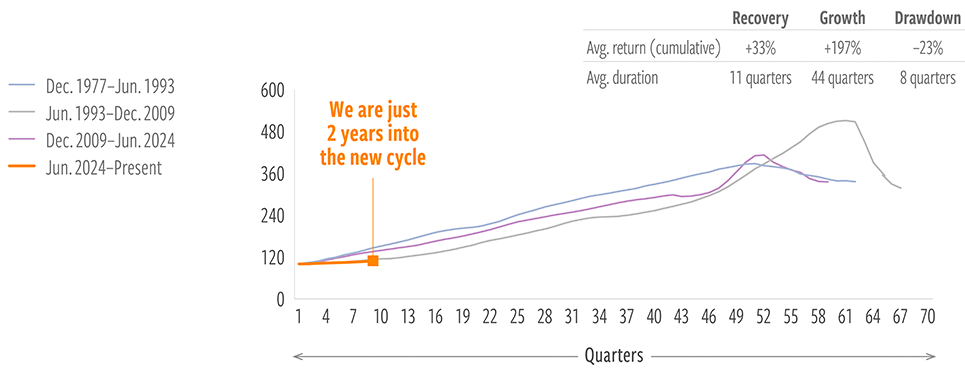
- Private real estate is nine quarters into its new cycle. Recovery to the prior peak has historically taken an average of 11 quarters, and the growth phase that follows has averaged 44 quarters (about 11 years) with a 197% cumulative return.
Investors often wait for evidence that a downturn is completely over before wading back into an out-of-favor asset class.
Then, when that evidence arrives in the form of a rally, they worry they’ve already missed the opportunity.
We’ve seen some of that in the questions we’re getting from clients about listed and private real estate, both of which have moved into new cycles.
And while no two cycles are the same, history provides useful perspective on how long real estate recoveries and expansions can last. They may last considerably longer than many investors realize.
We are in the early innings of the new listed real estate cycle
Historical listed real estate cycles (Index = 100)
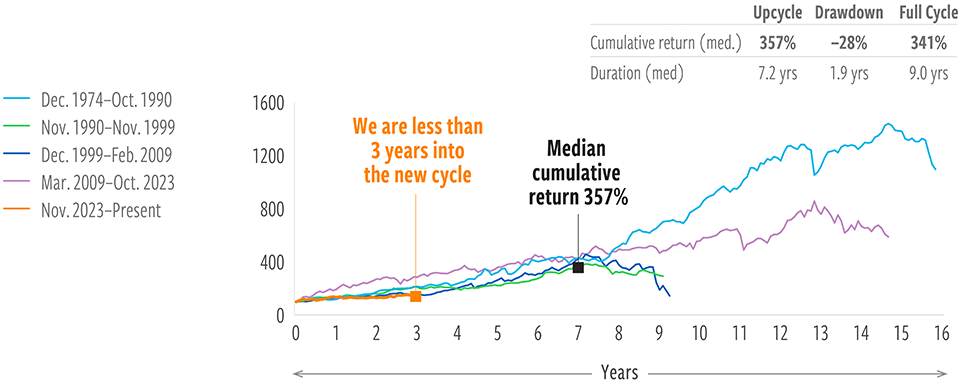
At September 30, 2026. Source: Cohen & Steers.
Data quoted represents past performance, which is no guarantee of future results. There is no guarantee that any historical trend illustrated above will be repeated in the future, and there is no way to predict precisely when such a trend will begin. The information presented above does not reflect the performance of any fund or other account managed or serviced by Cohen & Steers, and there is no guarantee that investors will experience the type of performance reflected above.
Let’s start with listed real estate.
Listed real estate fell 33% from peak to trough from late 2021 to late 2023, as real rates surged, pushing up the cost of capital and driving a sharp repricing in real estate values.
Since bottoming, REITs have recovered roughly 40%. Yet history suggests the new cycle may still have considerable room to run.
Three years may sound like a long time. But historically, listed real estate upcycles have lasted a median of more than seven years, while full cycles have lasted a median of nine years.
And while the 33% decline in the previous downturn was broadly consistent with the 28% median historical drawdown, the contrast with the periods that followed is striking: historical upcycles have generated a median cumulative return of 357%.
Past performance is no guarantee of future results, of course. And no one knows precisely how long or how far the current cycle will run.
But history provides important perspective: a meaningful recovery does not necessarily mean the opportunity is over. In previous cycles, it has often been just one part of a much longer period of expansion.
Private real estate entered its new cycle later, reflecting the familiar lead-lag relationship between the two markets.
Listed real estate has historically led private real estate through downturns and recoveries because public markets reprice changing expectations more quickly, while appraisal-based private-market valuations adjust more gradually. We’ve seen that pattern again in this cycle.
Property cash flow is accelerating
Cash flow growth (FAD)
As of June 30, 2026. Source: Cohen & Steers.
Data quoted represents past performance, which is no guarantee of future results. (1) ODCE is represented by the NCREIF Fund Index—Open-End Diversified Core Equity Index (NFI-ODCE) – Gross Total Returns.
Downturns have also been less frequent in private real estate. In fact, the reset that began in 2023 was only the third private real estate downturn in the past 30 years.
But when private real estate has emerged from previous downturns, the periods of recovery and growth that followed have been sustained.
We’re now nine quarters into the new private real estate cycle. Historically, the recovery from the trough back to the previous peak has taken an average of 11 quarters.
And that’s only the recovery phase. After returning to its previous peak, private real estate has historically entered a growth phase lasting an average of 44 quarters, or approximately 11 years, and generating an average cumulative return of 197%.
The lesson isn’t that this cycle will follow exactly the same path. It’s that real estate downturns have historically been much shorter than the periods of recovery and growth that followed.
So rather than asking whether the recent recovery means investors have missed the opportunity, we think there’s a better question:
Where are we in the new cycle, and where are the best opportunities from here? The recovery is no longer something we’re waiting for. It’s underway.
And history suggests that real estate cycles can have a long way to run after the recovery begins.
ABOUT THE AUTHORS

Seth Laughlin, Senior Vice President, is Head of Real Estate Strategy & Research, responsible for identifying allocation opportunities in both listed and private real estate and related thematic and strategic research.
Data quoted represents past performance, which is no guarantee of future results. The information presented does not reflect the performance of any fund or account managed or serviced by Cohen & Steers, and there is no guarantee that investors will experience the type of performance reflected. There is no guarantee that any market forecast set forth in this video will be realized. There is no guarantee that any historical trend referenced herein will be repeated in the future, and there is no way to predict precisely when such a trend will begin. The mention of specific securities is not a recommendation or solicitation to buy, sell or hold any particular security and should not be relied upon as investment advice.
This video is for informational purposes and reflects prevailing conditions and our judgment as of November 2026, which are subject to change. This material should not be relied upon as investment advice, does not constitute a recommendation to buy or sell a security or other investment and is not intended to predict or depict performance of any investment. This material is not being provided in a fiduciary capacity and is not intended to recommend any investment policy or investment strategy or take into account the specific objectives or circumstances of any investor. We consider the information in this video to be accurate, but we do not represent that it is complete or should be relied upon as the sole source of appropriateness for investment. Please consult with your investment, tax or legal professional regarding your individual circumstances prior to investing.
Investment risk: The risks of investing in real estate securities are similar to those associated with direct investments in real estate, including falling property values due to increasing vacancies; declining rents resulting from economic, legal, political or technological developments; lack of liquidity; limited diversification; and sensitivity to certain economic factors such as interest rate changes and market recessions. No representation or warranty is made as to the efficacy of any particular strategy or fund or the actual returns that may be achieved.
Cohen & Steers Capital Management, Inc. (Cohen & Steers) is a U.S. registered investment advisory firm that provides investment management services to corporate retirement, public and union retirement plans, U.S. endowments, foundations and mutual funds. Cohen & Steers UK Limited is authorized and regulated by the Financial Conduct Authority (FRN458459). Cohen & Steers Asia Limited is authorized and regulated by the Securities and Futures Commission of Hong Kong (ALZ367). Cohen & Steers Japan Limited is a registered financial instruments operator (investment advisory and agency business and discretionary investment management business with the Financial Services Agency of Japan and the Kanto Local Finance Bureau No. 3157) and is a member of the Japan Investment Advisers Association. Cohen & Steers Ireland Limited is regulated by the Central Bank of Ireland (No.C188319). Cohen & Steers Singapore Private Limited is a private company limited by shares in the Republic of Singapore.