

Welcome to the Real Estate Reel from Cohen & Steers.
KEY TAKEAWAYS
- Towers remain essential digital infrastructure: Satellite connectivity may expand, but dense terrestrial tower networks remain critical for the speed, capacity and reliability required by modern mobile, AI and data-intensive applications.
- Housing policy is becoming more supportive: The 21st Century ROAD to Housing Act reinforces the need for greater U.S. housing supply and appears constructive for single-family rental and manufactured housing operators.
- Data center constraints may strengthen incumbents: Rising scrutiny around power, water and grid impacts could increase the value of entitled land, utility access and existing development pipelines for established data center operators.
This month, rather than focusing on a single sector or topic, I want to highlight three real estate headlines we’re watching closely, and what they may mean for investors.
Periods of rising rates are typically driven by a strengthening economy, typified by improving GDP growth, job creation, and capacity constraints, which can lead to inflationary pressure.
And those same forces tend to support real estate fundamentals.
1. Towers and satellites
Let’s start with towers.
It’s been a difficult few years for the sector.
Tower REITs entered the rate-hiking cycle at elevated valuations and were pressured by higher interest rates, slower-than-expected 5G deployment, and carrier consolidation following T-Mobile’s acquisition of Sprint.
More recently, investors have questioned whether SpaceX’s satellite systems could become meaningful competitors.
Here’s our view:
EXHIBIT 1
Global mobile data traffic forecast
Exabytes per month(1)
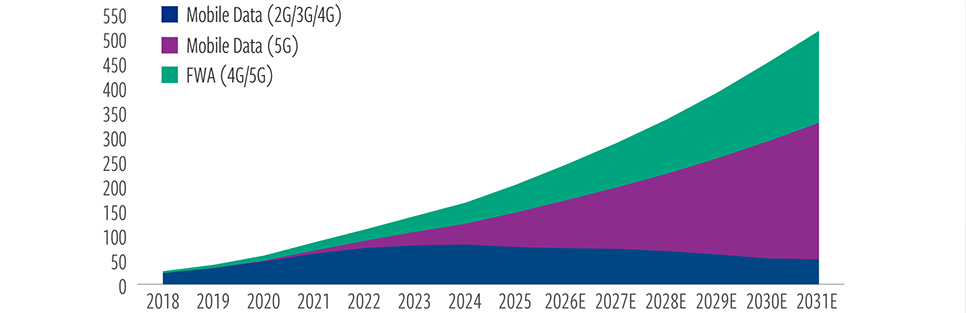
At June 30, 2026, unless otherwise noted. Ericsson Mobility Report and Cohen & Steers estimates.
Data quoted represents past performance, which is no guarantee of future results.
(1) One exabyte equals on billion gigabytes
Mobile data demand continues to grow as consumers spend more time on connected devices and AI-powered applications drive increasingly data-intensive activity.
At the same time, valuations have reset significantly and earnings growth is expected to reaccelerate over the next several years.
We remain constructive because towers are essential digital infrastructure.
While investors often focus on data centers, wireless networks are what ultimately connect the computing power to consumers.
And while satellite connectivity will continue to expand, we believe it complements, rather than replaces, terrestrial networks.
Dense tower networks will remain critical for the speed, capacity, and reliability required by modern applications.
That long-term demand backdrop is why we maintain an overweight position in the sector.
2. Housing affordability
The second headline is housing affordability.
In July, the 21st Century ROAD to Housing Act became law, representing one of the most significant bipartisan housing initiatives in years.
The legislation is designed to increase housing supply, streamline development processes, encourage zoning reform, and improve affordability.
For real estate investors, several provisions stand out.
The final legislation removed a proposal to force institutional investors to sell single-family rental homes after seven years.
That provision was a major overhang for the sector.
The final version also includes carve-outs for build-to-rent communities and newly constructed homes, areas in which single-family REITs have notable advantages.
The bill also includes important reforms for manufactured housing, including expanded financing options and changes that could make manufactured homes more accessible and affordable.
Overall, we view the legislation as supportive for both single-family rental and manufactured housing operators.
3. Data center moratoriums
Our third headline involves one of this year’s strongest performing property types: data centers.
Demand remains extremely high, driven by artificial intelligence, cloud computing, and the ongoing growth of digital infrastructure.
But we’re beginning to see increasing political and regulatory scrutiny around new development.
Recently, the state of New York implemented a one-year moratorium on new hyperscale data centers while it evaluates issues such as power demand, water consumption, and grid impacts.
The city of Charlotte, North Carolina also approved a temporary moratorium on new data center development applications as local officials consider how best to regulate future growth.
While these actions create headlines, our takeaway is nuanced.
In the near term, most developments currently underway can continue moving forward.
But the bigger story may be what these restrictions tell us about the future.
Power availability is becoming one of the scarcest resources in digital infrastructure.
Projects that already have entitled land, utility access, and available capacity are becoming increasingly valuable.
In other words, regulatory friction may actually reinforce the competitive advantages of established operators and increase the value of existing development pipelines.
ABOUT THE AUTHORS

Seth Laughlin, Senior Vice President, is Head of Real Estate Strategy & Research, responsible for identifying allocation opportunities in both listed and private real estate and related thematic and strategic research.
Data quoted represents past performance, which is no guarantee of future results. The information presented does not reflect the performance of any fund or account managed or serviced by Cohen & Steers, and there is no guarantee that investors will experience the type of performance reflected. There is no guarantee that any market forecast set forth in this video will be realized. There is no guarantee that any historical trend referenced herein will be repeated in the future, and there is no way to predict precisely when such a trend will begin. The mention of specific securities is not a recommendation or solicitation to buy, sell or hold any particular security and should not be relied upon as investment advice.
This video is for informational purposes and reflects prevailing conditions and our judgment as of July 2026, which are subject to change. This material should not be relied upon as investment advice, does not constitute a recommendation to buy or sell a security or other investment and is not intended to predict or depict performance of any investment. This material is not being provided in a fiduciary capacity and is not intended to recommend any investment policy or investment strategy or take into account the specific objectives or circumstances of any investor. We consider the information in this video to be accurate, but we do not represent that it is complete or should be relied upon as the sole source of appropriateness for investment. Please consult with your investment, tax or legal professional regarding your individual circumstances prior to investing.
Cohen & Steers Capital Management, Inc. (Cohen & Steers) is a U.S. registered investment advisory firm that provides investment management services to corporate retirement, public and union retirement plans, U.S. endowments, foundations and mutual funds. Cohen & Steers UK Limited is authorized and regulated by the Financial Conduct Authority (FRN458459). Cohen & Steers Asia Limited is authorized and regulated by the Securities and Futures Commission of Hong Kong (ALZ367). Cohen & Steers Japan Limited is a registered financial instruments operator (investment advisory and agency business and discretionary investment management business with the Financial Services Agency of Japan and the Kanto Local Finance Bureau No. 3157) and is a member of the Japan Investment Advisers Association. Cohen & Steers Ireland Limited is regulated by the Central Bank of Ireland (No.C188319). Cohen & Steers Singapore Private Limited is a private company limited by shares in the Republic of Singapore